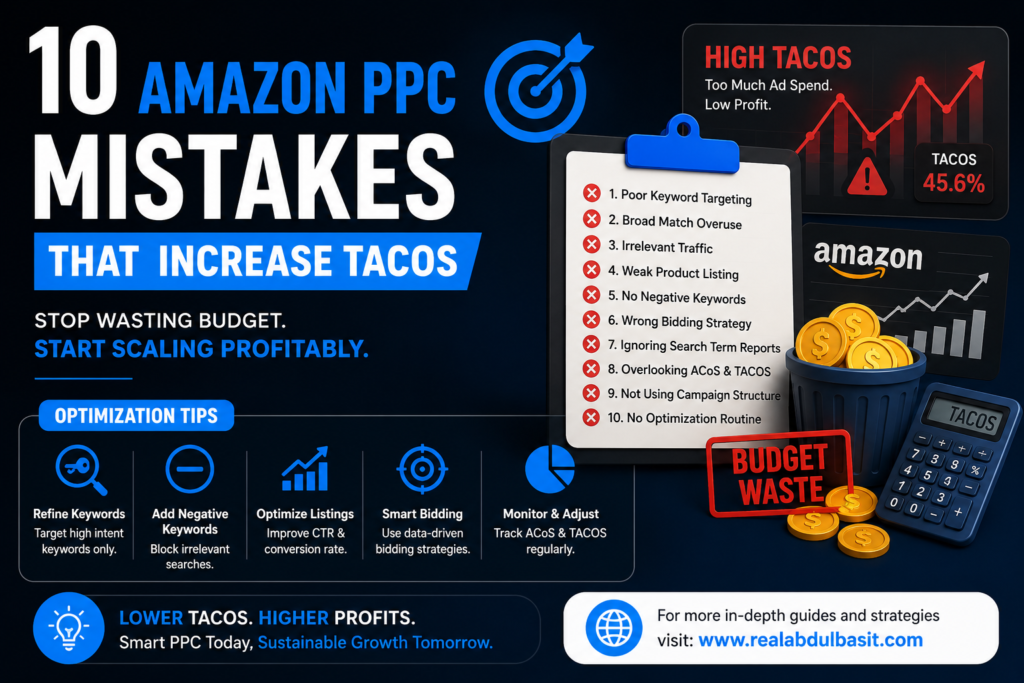
10 Amazon PPC Mistakes That Increase TACOS in 2026
Every Amazon seller wants lower advertising costs and higher profits.
Yet many sellers unknowingly make PPC mistakes that increase their TACOS (Total Advertising Cost of Sales) and reduce overall profitability.
The problem is that most sellers focus only on ACOS.
While ACOS helps measure advertising efficiency, TACOS shows how advertising impacts your entire business.
When TACOS continues rising, it often means one of two things:
- You’re wasting advertising budget.
- Your organic sales aren’t growing fast enough.
Both problems can hurt long-term growth.
The good news is that most TACOS issues are fixable.
In this guide, I’ll explain the most common Amazon PPC mistakes that increase TACOS and how you can avoid them.
Why TACOS Matters More Than Most Sellers Realize
TACOS measures advertising spend against total revenue.
TACOS Formula:
Advertising Spend ÷ Total Revenue × 100
Unlike ACOS, TACOS considers both:
- PPC sales
- Organic sales
This makes it one of the most important metrics for evaluating overall business performance.
A healthy TACOS often indicates:
- Strong organic rankings
- Efficient advertising
- Sustainable growth
- Better profitability
Mistake #1: Focusing Only on ACOS
This is probably the most common mistake.
Many sellers obsess over lowering ACOS while ignoring overall business growth.
For example:
A campaign may have a 15% ACOS but contribute very little to organic growth.
Meanwhile, another campaign may have a higher ACOS while helping improve rankings and total sales.
Always evaluate ACOS and TACOS together.
Mistake #2: Ignoring Search Term Reports
Search term reports reveal exactly where your advertising budget is being spent.
Unfortunately, many sellers rarely review them.
This often leads to spending money on:
- Irrelevant searches
- Low-converting keywords
- Unprofitable traffic
Regular search term audits help eliminate waste.
Mistake #3: Not Using Negative Keywords
Negative keywords are one of the easiest ways to improve efficiency.
Without them, Amazon may continue showing ads for irrelevant searches.
This creates:
- Higher costs
- Lower conversion rates
- Increased TACOS
Adding negative keywords regularly can dramatically improve performance.
Mistake #4: Targeting Too Many Keywords
Many sellers believe more keywords automatically lead to more sales.
That’s not always true.
Spreading budgets across hundreds of keywords often reduces efficiency.
Instead, focus on:
- High-converting keywords
- Relevant buyer-intent searches
- Proven performers
Quality beats quantity.
Mistake #5: Keeping Poor-Performing Keywords Active
Every campaign contains keywords that simply don’t work.
These keywords often generate:
- Clicks
- Spend
- Little or no revenue
Allowing them to continue running increases TACOS unnecessarily.
Review performance regularly and make adjustments.
Mistake #6: Weak Product Listings
PPC can drive traffic.
However, it cannot fix poor conversion rates.
If your listing doesn’t convert, advertising becomes expensive.
Common listing issues include:
- Poor images
- Weak titles
- Unclear bullet points
- Weak A+ Content
Improving conversion rates often lowers TACOS without reducing traffic.
Why Conversion Rate Matters
Amazon rewards products that convert.
Higher conversion rates generally lead to:
- More sales
- Better rankings
- Improved profitability
Every click becomes more valuable.
Mistake #7: Overbidding on Competitive Keywords
Competitive keywords often attract aggressive bidding.
Many sellers increase bids too quickly.
This can lead to:
- Higher CPCs
- Reduced profitability
- Increased TACOS
Higher bids do not guarantee better results.
Always monitor performance carefully.
Mistake #8: Neglecting Organic Growth
Some sellers rely entirely on PPC.
This creates long-term dependency on advertising.
A business that depends exclusively on paid traffic often struggles with profitability.
Focus on:
- Organic rankings
- Review growth
- Listing optimization
- Brand building
Organic sales help reduce TACOS naturally.
Mistake #9: Poor Campaign Structure
Messy campaign structures make optimization difficult.
Common issues include:
- Too many keywords in one campaign
- Mixed match types
- Poor budget allocation
Organized campaigns provide better control and cleaner data.
A Better PPC Structure
Many successful sellers separate campaigns by:
- Match type
- Product category
- Keyword intent
- Performance level
This improves optimization opportunities.
Mistake #10: Making Decisions Too Quickly
Amazon PPC requires data.
Many sellers pause campaigns before collecting enough information.
This often leads to poor decisions.
Instead:
- Analyze trends
- Review performance consistently
- Avoid emotional reactions
Patience often improves results.
How These Mistakes Increase TACOS
Each mistake creates one or more problems:
| Mistake | Impact on TACOS |
|---|---|
| Ignoring Search Terms | Wasted spend |
| No Negative Keywords | Irrelevant traffic |
| Poor Listings | Low conversions |
| Overbidding | Higher CPCs |
| Weak Campaign Structure | Poor optimization |
| Ignoring Organic Growth | PPC dependency |
Over time, these issues compound.
How to Reduce TACOS Effectively
If your TACOS is increasing, focus on:
Improve Keyword Targeting
Prioritize high-converting keywords.
Use Negative Keywords
Block irrelevant traffic.
Optimize Listings
Increase conversion rates.
Improve Organic Rankings
Generate more non-ad sales.
Strengthen Campaign Structure
Create cleaner, easier-to-manage campaigns.
Monitor Data Regularly
Weekly reviews often catch problems before they become expensive.
My Approach to Lowering TACOS
Whenever TACOS begins rising, I focus on three areas first:
- Search term optimization
- Conversion rate improvements
- Organic ranking growth
These areas typically produce the biggest improvements.
Rather than cutting advertising aggressively, I focus on improving efficiency and increasing total revenue.
That approach usually delivers better long-term results.
Related Articles
You may also find these guides helpful:
- What Is TACOS in Amazon Advertising? Complete Beginner Guide
- TACOS vs ACOS: Which Amazon PPC Metric Actually Matters?
- I Reduced TACOS by 40% Using This Amazon PPC Strategy
- Amazon PPC Automation: Is AI Better Than Manual Campaigns?
You can also explore our Amazon PPC Management and Amazon Growth Consulting services.
External Resources
For additional learning, review:
- Amazon Seller University
- Amazon Advertising Learning Center
- Amazon Ads Help Documentation
These official resources provide valuable guidance on Amazon advertising best practices.
Frequently Asked Questions
What causes high TACOS on Amazon?
Common causes include wasted ad spend, poor conversion rates, weak organic rankings, and ineffective keyword targeting.
Is TACOS more important than ACOS?
Both metrics are important. ACOS measures advertising efficiency, while TACOS measures overall business impact and profitability.
How can I lower TACOS without reducing sales?
Focus on improving keyword quality, increasing conversion rates, and growing organic sales rather than simply reducing ad spend.
Do negative keywords reduce TACOS?
Yes. Negative keywords help eliminate irrelevant traffic and reduce wasted advertising spend.
How often should I review PPC campaigns?
Most experienced sellers review campaigns weekly to identify optimization opportunities and prevent budget waste.
Final Verdict
High TACOS is often a symptom of deeper PPC problems.
Fortunately, most of these issues are controllable.
By avoiding the mistakes covered in this guide, you can:
- Reduce wasted spend
- Improve campaign efficiency
- Increase profitability
- Strengthen organic growth
- Scale your Amazon business more effectively
The goal isn’t simply spending less on advertising.
The goal is generating more profitable sales.
That’s the real key to lowering TACOS and building a sustainable Amazon business in 2026.