TACOS vs ACOS: Which Amazon PPC Metric Actually Matters?
If you’ve spent any time managing Amazon PPC campaigns, you’ve probably heard sellers debating whether TACOS or ACOS is the more important metric.
Some sellers obsess over lowering ACOS.
Others focus heavily on TACOS.
So who’s right?
The truth is that both metrics matter. However, they measure different things.
Understanding the difference can completely change how you manage your Amazon advertising and grow your business.
In this guide, you’ll learn:
- What ACOS is
- What TACOS is
- The key differences between them
- Real-world seller scenarios
- When to focus on ACOS
- When to focus on TACOS
- How successful Amazon brands use both metrics together
By the end, you’ll know exactly which metric deserves your attention and why.
What Is ACOS?
ACOS stands for:
Advertising Cost of Sales
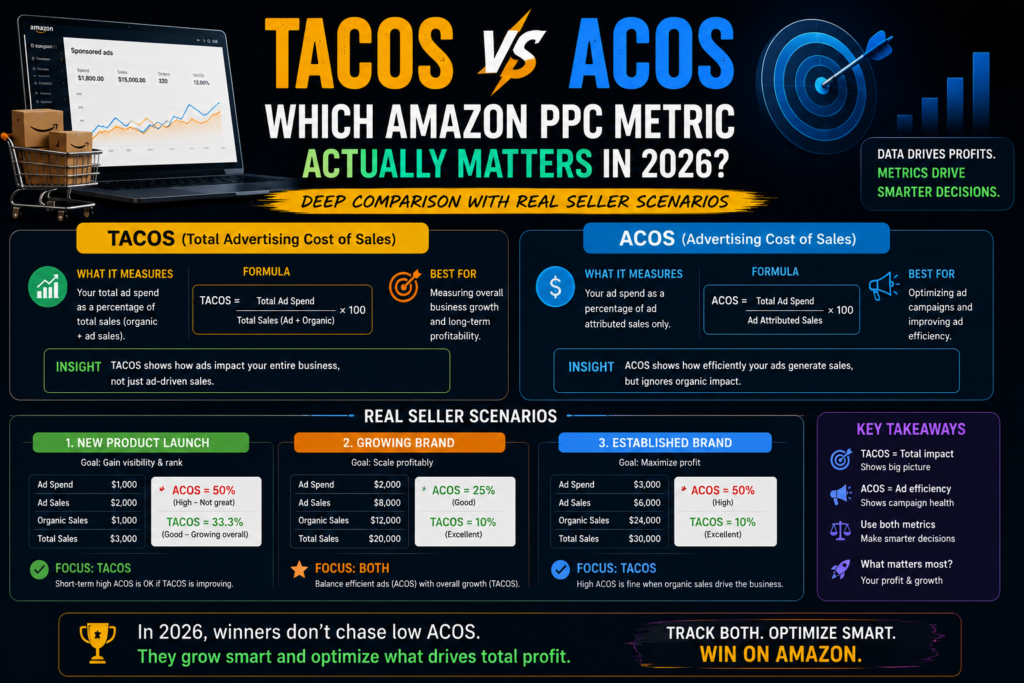
It measures how much you spend on advertising to generate advertising sales.
ACOS Formula
ACOS = Ad Spend ÷ Ad Revenue × 100
Example
Let’s say:
- Ad Spend = $1,000
- Ad Revenue = $5,000
Calculation:
$1,000 ÷ $5,000 × 100 = 20%
Your ACOS would be:
20%
This means you spent 20% of your ad-generated revenue on advertising.
What Is TACOS?
TACOS stands for:
Total Advertising Cost of Sales
Unlike ACOS, TACOS measures advertising spend against your total revenue.
This includes:
- PPC sales
- Organic sales
TACOS Formula
TACOS = Ad Spend ÷ Total Revenue × 100
Example
Let’s assume:
- Ad Spend = $1,000
- Total Revenue = $10,000
Calculation:
$1,000 ÷ $10,000 × 100 = 10%
Your TACOS would be:
10%
TACOS vs ACOS: The Core Difference
The easiest way to understand the difference is this:
ACOS measures ad efficiency.
TACOS measures business growth.
ACOS tells you how well your advertising performs.
TACOS tells you how advertising affects your entire Amazon business.
Quick Comparison Table
| Metric | Formula | Measures | Best For |
|---|---|---|---|
| ACOS | Ad Spend ÷ Ad Revenue | PPC Efficiency | Campaign Optimization |
| TACOS | Ad Spend ÷ Total Revenue | Overall Business Growth | Long-Term Scaling |
| ACOS | PPC-only metric | Short-term decisions | Bid management |
| TACOS | Business-wide metric | Long-term strategy | Organic growth analysis |
Why Many Beginners Focus Too Much on ACOS
When sellers first start Amazon PPC, they usually focus on one number:
ACOS.
This makes sense because it directly affects profitability.
However, focusing only on ACOS can create problems.
For example:
A seller may reduce bids aggressively to achieve a low ACOS.
While the metric looks great, sales volume drops.
Organic rankings decline.
Overall revenue decreases.
The PPC campaign becomes more efficient, but the business grows slower.
This is where TACOS becomes important.
Real Seller Scenario #1: The Low ACOS Trap
Imagine Seller A has:
- ACOS = 12%
- TACOS = 15%
At first glance, this looks excellent.
However:
- Sales are stagnant
- Organic rankings aren’t improving
- Revenue growth is slow
The seller is optimizing only for efficiency.
As a result, growth suffers.
This is a common mistake.
Real Seller Scenario #2: Higher ACOS, Better Growth
Seller B has:
- ACOS = 28%
- TACOS = 8%
Many beginners would panic seeing a 28% ACOS.
However:
- Organic rankings are improving
- Sales are growing every month
- Revenue is increasing
- Brand visibility is expanding
In this case, advertising is helping generate organic growth.
The higher ACOS is acting as an investment.
This seller may actually be in a stronger position.
Why TACOS Reflects Organic Growth
One of the biggest advantages of TACOS is that it reveals the relationship between advertising and organic sales.
As your product gains visibility, you often receive:
- More organic traffic
- Better keyword rankings
- Increased brand searches
- More repeat customers
When that happens, TACOS often decreases.
This usually indicates healthy business growth.
Example of Improving TACOS
Month 1
- Ad Spend = $2,000
- Total Revenue = $10,000
TACOS = 20%
Month 4
- Ad Spend = $2,000
- Total Revenue = $20,000
TACOS = 10%
The ad spend remained the same.
However, total sales doubled.
This suggests advertising contributed to stronger organic performance.
When ACOS Matters Most
There are situations where ACOS deserves significant attention.
These include:
Campaign Optimization
ACOS helps identify:
- Wasteful keywords
- Poor-performing campaigns
- Unprofitable ad spend
Budget Management
Monitoring ACOS helps control costs and protect margins.
Bid Adjustments
Most bid optimization decisions rely heavily on ACOS data.
Profitability Analysis
ACOS helps determine whether individual campaigns are profitable.
When TACOS Matters Most
TACOS becomes increasingly important when evaluating long-term growth.
Product Launches
During launches, profitability isn’t always the primary goal.
Visibility often matters more.
TACOS helps measure overall progress.
Organic Ranking Strategies
If PPC is improving keyword rankings, TACOS often reflects that growth.
Brand Expansion
As brands scale, TACOS provides a better view of overall performance.
Long-Term Profitability
TACOS reveals whether your business is becoming less dependent on advertising.
What Is a Good ACOS?
Benchmarks vary by category.
However, many sellers use:
| ACOS Range | Interpretation |
|---|---|
| Below 15% | Excellent |
| 15%–25% | Healthy |
| 25%–35% | Common |
| Above 35% | Requires review |
Remember:
A good ACOS depends on your profit margins.
What Is a Good TACOS?
Generally:
| TACOS Range | Interpretation |
|---|---|
| Below 5% | Excellent |
| 5%–10% | Healthy |
| 10%–15% | Acceptable |
| 15%–25% | Common during launches |
| Above 25% | Needs investigation |
Again, context matters.
Why Successful Amazon Brands Track Both
Experienced Amazon operators rarely choose one metric over the other.
Instead, they monitor both.
ACOS answers:
Are my ads efficient?
TACOS answers:
Are my ads helping grow my business?
Together, they provide a complete picture.
Common Mistakes Sellers Make
Ignoring TACOS
Many sellers focus only on ad efficiency and miss long-term growth opportunities.
Ignoring ACOS
Others chase sales growth while wasting money on inefficient campaigns.
Looking at Metrics in Isolation
Always review:
- ACOS
- TACOS
- Conversion Rate
- Organic Sales
- Profit Margins
- Keyword Rankings
These metrics work together.
How I Personally View TACOS vs ACOS
If I had to choose only one metric for campaign optimization, I would choose ACOS.
If I had to choose only one metric for business growth, I would choose TACOS.
Fortunately, Amazon sellers don’t have to choose.
The most successful brands use both.
They optimize ACOS for efficiency while monitoring TACOS for growth.
This creates a balance between profitability and scaling.
Related Articles
You may also enjoy:
- What Is TACOS in Amazon Advertising? Complete Beginner Guide
- How to Rank Your Amazon Product Organically Without Spending Too Much on PPC
- 7 Amazon PPC Mistakes That Waste Your Budget
- Amazon PPC Automation: Is AI Better Than Manual Campaigns?
You can also explore our Amazon PPC Management and Amazon Growth Consulting services for additional support.
External Resources
For official Amazon advertising guidance, review:
- Amazon Seller University
- Amazon Advertising Learning Center
- Amazon Ads Help Documentation
These resources provide detailed information about Amazon PPC best practices.
Frequently Asked Questions
Is TACOS more important than ACOS?
Neither metric is more important. ACOS measures advertising efficiency, while TACOS measures overall business growth.
Can I have a good ACOS and bad TACOS?
Yes. A campaign may have efficient advertising performance while contributing little to total business growth.
Why is my ACOS high but TACOS low?
This often means advertising is helping generate organic sales and long-term growth.
What should new Amazon sellers focus on?
New sellers should monitor both metrics, but TACOS can be especially useful during product launches and ranking campaigns.
How often should I review TACOS?
Most experienced sellers review TACOS weekly or monthly alongside ACOS and other business metrics.
Final Verdict
The debate between TACOS vs ACOS isn’t really about choosing one metric over the other.
Both serve different purposes.
ACOS helps you optimize campaigns.
TACOS helps you understand business growth.
The most successful Amazon sellers use ACOS to improve advertising efficiency while using TACOS to measure the bigger picture.
If your goal is long-term profitability, stronger organic rankings, and sustainable growth, tracking both metrics is essential.
In 2026, smart Amazon sellers don’t ask whether TACOS or ACOS matters more.
They understand that both metrics work together to reveal the true health of their business.