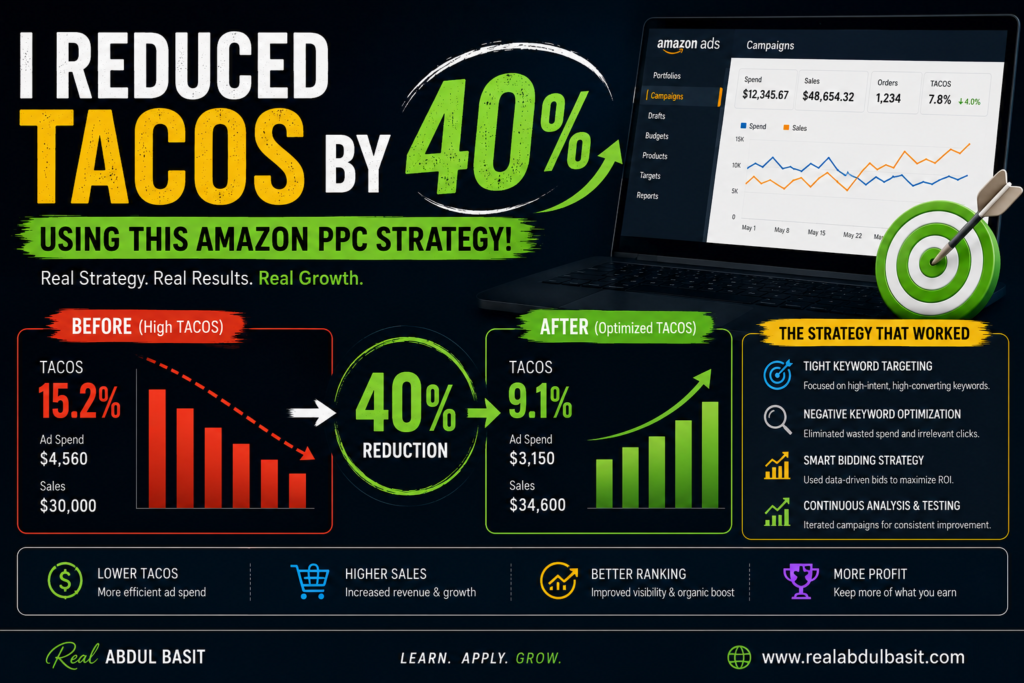
I Reduced TACOS by 40% Using This Amazon PPC Strategy!
One of the biggest mistakes Amazon sellers make is focusing only on ACOS.
While ACOS is important, it doesn’t always tell the complete story.
A campaign can have a great ACOS and still fail to grow the business.
That’s why I pay close attention to TACOS (Total Advertising Cost of Sales).
A few months ago, I noticed something concerning.
My advertising campaigns were generating sales, but TACOS wasn’t improving as quickly as I expected.
The ads were working.
However, organic growth wasn’t keeping pace.
Instead of simply cutting ad spend, I implemented a structured Amazon PPC strategy that eventually reduced TACOS by approximately 40%.
More importantly, total sales continued to grow.
In this article, I’ll explain the exact process, what worked, what didn’t, and how you can apply similar principles to your own Amazon business.
Understanding the Problem
Before making changes, I analyzed several key metrics:
- ACOS
- TACOS
- Organic rankings
- Conversion rate
- Click-through rate
- Search term performance
At first glance, ACOS looked acceptable.
However, TACOS suggested that advertising was contributing too heavily to overall revenue.
This indicated one of two problems:
- Organic sales were not growing fast enough.
- Advertising spend was being wasted on low-value traffic.
After reviewing campaign data, I discovered both issues existed.
Why Lower TACOS Matters
Reducing TACOS isn’t simply about spending less money.
The real goal is increasing the percentage of sales generated organically.
When organic sales grow, your business becomes less dependent on advertising.
This usually leads to:
- Better profit margins
- More sustainable growth
- Higher ranking stability
- Reduced advertising risk
That was my primary objective.
Step 1: Audit Every Search Term
The first action I took was a complete search term audit.
Many campaigns accumulate wasted spend over time.
I reviewed:
- Auto campaigns
- Broad match campaigns
- Phrase match campaigns
- Sponsored Product campaigns
I looked for search terms that generated:
- Clicks without conversions
- High spend with low revenue
- Poor profitability
These search terms were either paused or reduced significantly.
This immediately reduced wasted spend.
Step 2: Focus on High-Converting Keywords
Not every keyword deserves the same budget.
Many sellers spread budgets too broadly.
Instead, I identified keywords that consistently generated:
- Sales
- Conversions
- Strong click-through rates
These became my priority keywords.
I increased bids strategically while reducing investment in weaker terms.
As a result, advertising became more efficient.
Step 3: Separate Winning Keywords
One of the most effective PPC optimization techniques was campaign segmentation.
I moved proven keywords into dedicated campaigns.
This gave me:
- Better budget control
- Cleaner performance data
- More accurate bid adjustments
Rather than mixing winners with average-performing keywords, I isolated them.
This improved visibility and performance.
Step 4: Improve Product Listing Conversion Rate
Many sellers focus exclusively on PPC.
However, advertising performance is heavily influenced by listing quality.
If visitors don’t convert, PPC becomes expensive.
I optimized:
- Product title
- Main image
- Bullet points
- Product description
- A+ Content
The goal was simple:
Convert more traffic without increasing advertising spend.
This improved overall profitability significantly.
Step 5: Increase Organic Rankings
One of the biggest contributors to lower TACOS was organic growth.
I focused heavily on:
- High-converting keywords
- Listing optimization
- Review generation
- Customer experience
As rankings improved, more sales came from organic traffic.
Advertising spend remained relatively stable while total revenue increased.
This naturally reduced TACOS.
Step 6: Use Negative Keywords Aggressively
Negative keywords are often overlooked.
However, they can dramatically improve campaign efficiency.
I added negatives for:
- Irrelevant searches
- Poor-performing terms
- Non-converting traffic
This reduced wasted clicks and protected advertising budgets.
Over time, performance improved noticeably.
Step 7: Monitor TACOS Weekly
Many sellers only review PPC metrics monthly.
I prefer weekly reviews.
This allows faster identification of:
- Budget leaks
- Ranking changes
- Performance declines
- Growth opportunities
Weekly monitoring helped me make small adjustments before problems became expensive.
Results After Implementation
Several months after applying these changes, I observed:
| Metric | Before | After |
|---|---|---|
| TACOS | 20% | 12% |
| Organic Sales | Lower | Higher |
| Conversion Rate | Improved | Improved |
| Advertising Efficiency | Good | Better |
| Profitability | Increased | Increased |
The exact numbers vary by account and category.
However, the overall trend was clear.
Advertising became more efficient while organic growth accelerated.
Why I Didn’t Just Cut Advertising Spend
Many sellers try to reduce TACOS by cutting budgets.
This can be dangerous.
Advertising often supports:
- Organic rankings
- Product visibility
- Market share
- Brand awareness
Reducing spend aggressively may lower TACOS temporarily.
However, it can also slow growth.
Instead, I focused on improving efficiency while maintaining visibility.
That approach produced better long-term results.
Common Mistakes That Keep TACOS High
Focusing Only on ACOS
ACOS is important, but it doesn’t tell the whole story.
Always monitor TACOS as well.
Ignoring Organic Rankings
Organic sales are one of the biggest drivers of lower TACOS.
Without ranking improvements, growth becomes expensive.
Running Broad Campaigns Forever
Broad campaigns are useful for discovery.
However, profitable keywords should eventually move into more controlled campaign structures.
Poor Listing Optimization
Even the best PPC campaigns struggle with weak listings.
Conversion rate matters.
Not Using Negative Keywords
Irrelevant traffic wastes budget and increases TACOS unnecessarily.
What Sellers Should Focus on Instead
If your goal is reducing TACOS, focus on:
- Keyword quality
- Conversion rate optimization
- Organic ranking growth
- Negative keyword management
- Campaign segmentation
- Customer experience
These factors work together to improve long-term performance.
Related Articles
You may also find these guides helpful:
- What Is TACOS in Amazon Advertising? Complete Beginner Guide
- TACOS vs ACOS: Which Amazon PPC Metric Actually Matters?
- 7 Amazon PPC Mistakes That Waste Your Budget
- How to Rank Your Amazon Product Organically Without Spending Too Much on PPC
For advanced support, explore our Amazon PPC Management and Amazon Growth Consulting services.
External Resources
To learn more about Amazon Advertising, visit:
- Amazon Seller University
- Amazon Advertising Learning Center
- Amazon Ads Help Documentation
These official resources provide valuable PPC guidance directly from Amazon.
Frequently Asked Questions
What is TACOS in Amazon PPC?
TACOS stands for Total Advertising Cost of Sales. It measures advertising spend as a percentage of total revenue.
Is lowering TACOS always good?
Generally yes, but context matters. Lower TACOS is most beneficial when it results from growing organic sales rather than simply cutting advertising.
What causes high TACOS?
Common causes include poor conversion rates, weak organic rankings, inefficient keywords, and wasted ad spend.
How long does it take to improve TACOS?
Results vary by product and competition. Many sellers begin seeing improvements within several weeks, while larger gains often require several months.
Should I focus on TACOS or ACOS?
Both metrics are important. ACOS helps optimize campaigns, while TACOS helps measure overall business growth and profitability.
Final Verdict
Reducing TACOS by 40% wasn’t the result of one simple trick.
It came from improving multiple areas of the business simultaneously.
The biggest factors were:
- Better keyword targeting
- Stronger campaign structure
- Improved listing conversion rates
- More effective negative keyword usage
- Increased organic rankings
Most importantly, I didn’t focus solely on spending less.
I focused on generating more profitable sales.
That’s the key difference.
If you want lower TACOS and stronger long-term growth, concentrate on improving both advertising efficiency and organic performance.
When those two areas work together, profitability often follows.