Why Your Amazon Product Is Not Ranking Organically?
One of the most frustrating situations for Amazon sellers is launching a product, optimizing the listing, running PPC campaigns, and still not seeing organic ranking improvements.
You may have invested time and money into your business, yet your product remains buried on page three, page five, or even worse.
The good news is that Amazon rankings are not random.
In most cases, there are specific reasons why a product isn’t ranking organically.
The better news is that these problems can usually be identified and fixed.
In this guide, I’ll explain the most common reasons Amazon products fail to rank, how to diagnose ranking issues, and what you can do to improve your organic visibility in 2026.
How Amazon Organic Ranking Actually Works
Before diagnosing problems, it’s important to understand what Amazon wants.
Amazon’s algorithm is designed to show products that are most likely to generate sales while delivering a positive customer experience.
To rank organically, your product must demonstrate:
- Relevance
- Strong conversion rates
- Consistent sales
- Positive customer feedback
- Reliable inventory levels
If one or more of these factors are weak, rankings can suffer.
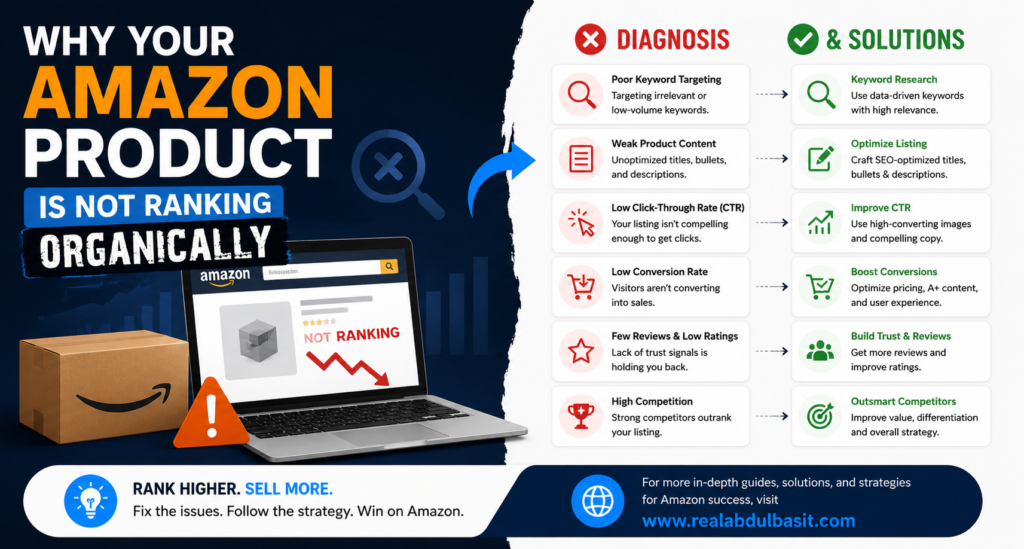
Problem #1: You’re Targeting the Wrong Keywords
One of the most common mistakes sellers make is targeting keywords that are either too competitive or not relevant enough.
For example, a new seller trying to rank for a highly competitive keyword may struggle against established brands with years of sales history.
Instead, focus on:
- Long-tail keywords
- Buyer-intent keywords
- Lower-competition opportunities
Ranking for smaller keywords often leads to stronger growth over time.
How to Check Keyword Relevance
Ask yourself:
- Is the keyword directly related to the product?
- Would a customer searching this keyword actually buy my product?
- Are top-ranking competitors targeting the same keyword?
If the answer is no, ranking will be difficult.
Problem #2: Your Listing Isn’t Fully Optimized
Many sellers believe adding keywords is enough.
It’s not.
Amazon needs to clearly understand what your product is.
Important areas include:
Product Title
Include primary keywords naturally.
Avoid keyword stuffing.
Bullet Points
Highlight benefits while reinforcing keyword relevance.
Product Description
Answer customer questions and improve confidence.
Backend Search Terms
Use additional relevant keywords that don’t fit naturally in the visible listing.
A weak listing limits ranking potential.
Problem #3: Low Conversion Rate
This is one of the biggest ranking killers.
Even if Amazon sends traffic to your listing, poor conversions tell the algorithm that shoppers aren’t interested.
As a result, rankings often decline.
Amazon rewards products that convert.
Signs of a Conversion Problem
Common indicators include:
- High traffic but low sales
- Strong impressions but few orders
- Good PPC clicks but poor results
If customers visit but don’t buy, your conversion rate needs attention.
How to Improve Conversion Rate
Focus on:
- Better product images
- Improved pricing
- Stronger copywriting
- Enhanced A+ Content
- Clear product benefits
- Better customer trust signals
Small improvements can make a significant difference.
Problem #4: You’re Not Generating Enough Sales Velocity
Amazon wants evidence that customers want your product.
Sales velocity is one of the strongest ranking signals.
Products that generate more sales often receive better organic visibility.
This is why ranking and sales are closely connected.
Why PPC Often Helps Organic Rankings
Many sellers ask:
“Does Amazon PPC improve organic rankings?”
Indirectly, yes.
PPC generates:
- Visibility
- Traffic
- Sales
Those sales create performance signals that can improve organic rankings.
That’s why PPC is often part of successful ranking strategies.
Problem #5: Your Main Image Isn’t Competitive
Before customers buy, they must click.
Your main image directly impacts click-through rate.
If shoppers ignore your product in search results, Amazon notices.
Lower click-through rates often result in weaker rankings.
Characteristics of High-Converting Images
Successful images usually offer:
- High clarity
- Professional quality
- Strong product visibility
- Clear differentiation
The goal is to stand out in crowded search results.
Problem #6: Poor Review Performance
Reviews influence both customer behavior and ranking performance.
Products with poor ratings often struggle to compete.
Customers naturally trust products with stronger review profiles.
What Review Metrics Matter?
Focus on:
- Average rating
- Review quality
- Customer satisfaction
- Review consistency
Improving product quality often improves reviews naturally.
Problem #7: Inventory Problems
Many sellers underestimate the impact of inventory management.
Running out of stock can significantly damage rankings.
When inventory disappears:
- Sales stop
- Ranking momentum declines
- Organic visibility drops
Recovery can take time.
Why Inventory Planning Matters
Consistent availability sends positive signals to Amazon.
Avoiding stockouts should be a priority.
Problem #8: You’re Expecting Results Too Quickly
Organic ranking takes time.
Amazon needs data.
New products often require:
- Traffic
- Sales history
- Customer feedback
- Conversion data
Patience is part of the process.
Many sellers quit optimization efforts before the algorithm has enough information.
Problem #9: Your Competition Is Simply Better
This may be difficult to hear.
However, sometimes competitors rank higher because they offer:
- Better products
- Better branding
- Better listings
- Better reviews
- Better customer experiences
Instead of copying competitors, identify opportunities to outperform them.
How to Analyze Competitors
Review:
- Images
- Pricing
- Reviews
- Product features
- Listing quality
- Brand presence
This often reveals areas for improvement.
Problem #10: You’re Ignoring Brand Building
In 2026, branding matters more than ever.
Strong brands often achieve:
- Better click-through rates
- Higher conversion rates
- More repeat purchases
- Increased customer trust
Brand strength influences many of Amazon’s ranking signals.
Quick Ranking Diagnosis Checklist
If your product isn’t ranking, ask yourself:
✅ Are my target keywords relevant?
✅ Is my listing optimized?
✅ Is my conversion rate competitive?
✅ Am I generating enough sales velocity?
✅ Are my images strong enough?
✅ Do I have positive reviews?
✅ Am I maintaining inventory?
✅ Am I building a recognizable brand?
If multiple answers are “No,” you’ve likely identified the cause.
The Ranking Improvement Plan
If your rankings are struggling, focus on these priorities:
First Priority
- Listing optimization
- Keyword research
- Image improvements
Second Priority
- PPC optimization
- Conversion rate improvements
- Review growth
Third Priority
- Brand development
- Customer experience
- Long-term organic growth
This approach creates sustainable ranking improvements.
Related Articles
You may also find these guides helpful:
- How Amazon Organic Ranking Works in 2026
- How to Rank Your Amazon Product Organically Without Spending Too Much on PPC
- TACOS vs ACOS: Which Amazon PPC Metric Actually Matters?
- How to Build a Brand on Amazon Instead of Just Selling Products
You can also explore our Amazon SEO Optimization and Amazon Growth Consulting services for personalized support.
External Resources
For additional learning, review:
- Amazon Seller University
- Amazon Ads Learning Console
- Amazon Brand Registry
These official Amazon resources provide valuable guidance for sellers.
Frequently Asked Questions
Why is my Amazon product not ranking?
The most common causes include poor keyword targeting, weak conversion rates, low sales velocity, inventory issues, and insufficient customer reviews.
How long does it take to rank organically on Amazon?
It varies by niche and competition. Some products gain visibility within weeks, while others may require several months of optimization.
Does PPC help organic rankings?
Indirectly, yes. PPC generates sales and visibility, which create signals Amazon uses to evaluate ranking performance.
Can I rank without reviews?
It’s possible, but much more difficult. Reviews improve trust and conversion rates, both of which impact rankings.
What is the most important Amazon ranking factor?
There is no single ranking factor. Amazon evaluates relevance, conversions, sales velocity, customer satisfaction, and other performance signals together.
Final Verdict
If your Amazon product isn’t ranking organically, there is usually a reason.
The key is identifying the bottleneck.
In most cases, ranking issues come down to one or more of the following:
- Poor keyword targeting
- Weak listing optimization
- Low conversion rates
- Insufficient sales velocity
- Inventory problems
- Lack of reviews
- Weak branding
The sellers who consistently improve these areas are the ones who eventually dominate organic search results.
Amazon rankings are not won through shortcuts.
They are earned through better products, better customer experiences, and consistent optimization.
That’s how sustainable organic growth is built in 2026.