The Real Difference Between ACOS, TACOS, and ROAS
If you’ve spent any time managing Amazon PPC campaigns, you’ve probably heard the terms ACOS, TACOS, and ROAS.
Most sellers track these metrics.
However, many don’t fully understand what each one actually measures.
As a result, they often make optimization decisions based on incomplete information.
The truth is that ACOS, TACOS, and ROAS are not competing metrics.
They serve different purposes.
When used together, they provide a complete picture of advertising performance and business growth.
In this guide, I’ll explain the real difference between ACOS, TACOS, and ROAS, when to use each metric, and how successful Amazon sellers use them to scale profitably.
Why PPC Metrics Matter
Amazon PPC generates a large amount of data.
Without tracking the right metrics, it’s difficult to answer important questions such as:
- Is my advertising profitable?
- Am I wasting ad spend?
- Are my campaigns helping organic growth?
- Should I increase budgets?
- Am I scaling efficiently?
This is where ACOS, TACOS, and ROAS become valuable.
Each metric reveals something different.
What Is ACOS?
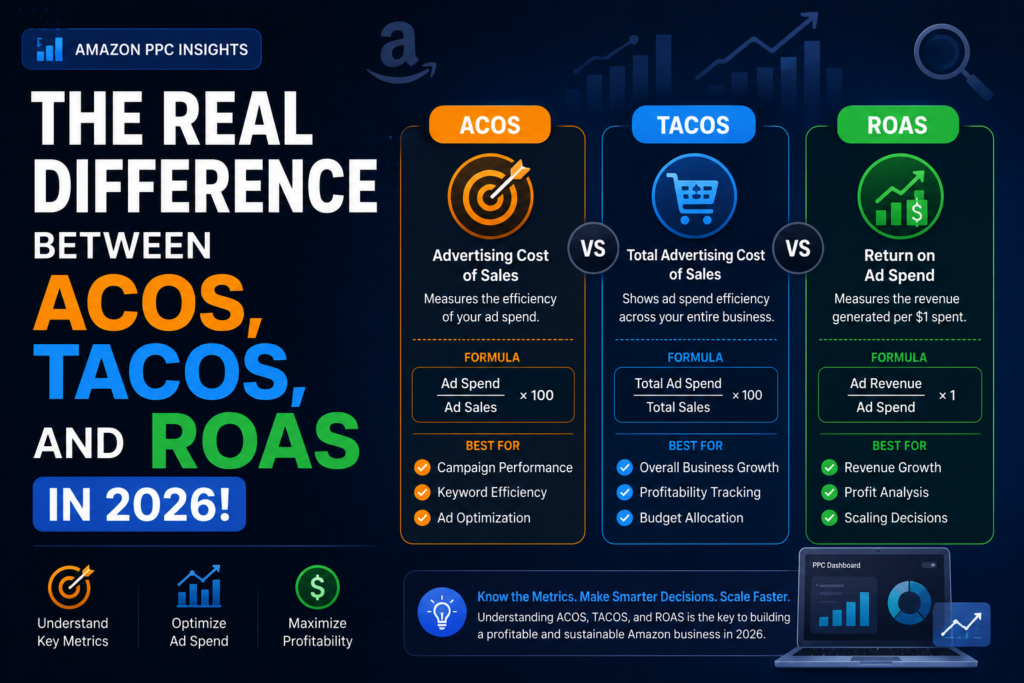
ACOS stands for:
Advertising Cost of Sales
It measures how much advertising spend is required to generate advertising revenue.
ACOS Formula
ACOS=\frac{Advertising\ Spend}{Ad\ Revenue}\times100
Example
If:
- Ad Spend = $500
- Ad Revenue = $2,500
Then:
ACOS = 20%
This means you spent 20 cents in advertising for every dollar of ad-generated sales.
What ACOS Tells You
ACOS helps measure:
- Campaign efficiency
- Keyword profitability
- Bid performance
- Advertising effectiveness
It is primarily a campaign-level metric.
Benefits of ACOS
- Easy to calculate
- Useful for PPC optimization
- Helps identify waste
- Supports bid decisions
Because of these advantages, ACOS remains one of the most widely used Amazon advertising metrics.
Limitations of ACOS
ACOS only looks at advertising-generated sales.
It does not account for:
- Organic sales
- Brand growth
- Long-term ranking improvements
- Total business performance
This is why relying exclusively on ACOS can be misleading.
What Is TACOS?
TACOS stands for:
Total Advertising Cost of Sales
Unlike ACOS, TACOS compares advertising spend against total revenue.
TACOS Formula
TACOS=\frac{Advertising\ Spend}{Total\ Revenue}\times100
Example
If:
- Ad Spend = $500
- Total Revenue = $10,000
Then:
TACOS = 5%
This means advertising accounts for 5% of total sales.
What TACOS Tells You
TACOS measures:
- Overall business efficiency
- Dependence on advertising
- Organic growth performance
- Long-term profitability
This makes TACOS a broader business metric.
Why Many Experts Prefer TACOS
A campaign can have a high ACOS while still contributing to healthy business growth.
For example:
A product launch may intentionally run higher ACOS campaigns to generate rankings.
If organic sales grow significantly, TACOS may remain healthy.
This provides a more complete picture.
Benefits of TACOS
- Measures total business impact
- Tracks organic growth
- Reveals advertising dependency
- Helps evaluate scaling efficiency
For long-term sellers, TACOS often becomes one of the most important metrics.
What Is ROAS?
ROAS stands for:
Return on Advertising Spend
It measures how much revenue is generated for every dollar spent on advertising.
ROAS Formula
ROAS=\frac{Ad\ Revenue}{Advertising\ Spend}
Example
If:
- Ad Revenue = $5,000
- Ad Spend = $1,000
Then:
ROAS = 5
This means every $1 spent generated $5 in revenue.
What ROAS Tells You
ROAS measures:
- Advertising return
- Revenue efficiency
- Campaign performance
Many agencies and advertising platforms use ROAS because it is easy to interpret.
ACOS vs ROAS
Interestingly, ACOS and ROAS are essentially inverse calculations.
Example
| Metric | Value |
|---|---|
| ACOS | 20% |
| ROAS | 5 |
Both describe the same performance from different perspectives.
ACOS vs TACOS vs ROAS Comparison
| Metric | Formula | Purpose |
|---|---|---|
| ACOS | Ad Spend ÷ Ad Revenue | Campaign efficiency |
| TACOS | Ad Spend ÷ Total Revenue | Business growth |
| ROAS | Ad Revenue ÷ Ad Spend | Advertising return |
Each metric answers a different question.
When to Use ACOS
ACOS is most useful when optimizing:
- Keywords
- Campaigns
- Bids
- Search terms
If you’re making tactical PPC decisions, ACOS is valuable.
When to Use TACOS
TACOS is ideal for evaluating:
- Business profitability
- Organic ranking growth
- Advertising dependence
- Long-term strategy
This metric is especially important for scaling brands.
When to Use ROAS
ROAS works well for:
- Quick performance reviews
- Budget decisions
- Revenue analysis
- Agency reporting
Many marketers prefer ROAS because it is straightforward.
Real Seller Scenario
Imagine two products.
Product A
- ACOS: 15%
- TACOS: 12%
Product B
- ACOS: 25%
- TACOS: 6%
At first glance, Product A appears better.
However, Product B generates significantly more organic sales.
As a result, overall profitability may actually be stronger.
This is why TACOS often provides deeper insights.
Which Metric Matters Most?
The answer depends on your objective.
If You Want Better PPC Efficiency
Focus on ACOS.
If You Want Long-Term Business Growth
Focus on TACOS.
If You Want Revenue Return Analysis
Focus on ROAS.
The best sellers monitor all three.
Common Mistakes Sellers Make
Obsessing Over ACOS
Lower ACOS isn’t always better.
Sometimes higher ACOS supports organic growth.
Ignoring TACOS
Many sellers never evaluate how advertising impacts total business performance.
Looking Only at Revenue
ROAS can appear impressive while profits remain weak.
Always consider margins.
Making Decisions Based on One Metric
No single metric tells the entire story.
Multiple metrics create better insights.
My Approach to PPC Performance Analysis
When evaluating campaigns, I generally use:
ACOS
For campaign optimization.
TACOS
For business growth analysis.
ROAS
For advertising efficiency reviews.
Together, these metrics provide a complete performance picture.
Related Articles
You may also find these guides helpful:
- What Is TACOS in Amazon Advertising? Complete Beginner Guide
- TACOS vs ACOS: Which Amazon PPC Metric Actually Matters?
- 10 Amazon PPC Mistakes That Increase TACOS
- I Reduced TACOS by 40% Using This Amazon PPC Strategy
You can also explore our Amazon PPC Management and Amazon Growth Consulting services.
External Resources
For additional learning, review:
These resources provide official guidance on Amazon advertising metrics and optimization.
Frequently Asked Questions
What is the difference between ACOS and TACOS?
ACOS measures ad spend against ad-generated revenue, while TACOS measures ad spend against total revenue, including organic sales.
Is ROAS the opposite of ACOS?
Yes. ROAS and ACOS represent the same data from opposite perspectives.
Which metric is best for Amazon PPC?
There is no single best metric. ACOS, TACOS, and ROAS each provide unique insights.
What is a good TACOS on Amazon?
Many established brands aim for a TACOS between 5% and 10%, although targets vary by category and growth stage.
Why is TACOS important?
TACOS helps sellers understand whether advertising is contributing to overall business growth rather than simply generating ad sales.
Final Verdict
ACOS, TACOS, and ROAS are all important Amazon PPC metrics.
However, they measure different aspects of performance.
- ACOS helps optimize campaigns.
- TACOS measures overall business growth.
- ROAS evaluates advertising returns.
The most successful Amazon sellers don’t choose one metric over another.
Instead, they use all three together to make smarter decisions, improve profitability, and scale their businesses more effectively.
In 2026, understanding these metrics is no longer optional.
It’s a requirement for sustainable Amazon growth.