Sponsored Products vs Sponsored Brands: Which Delivers Better ROI?
Amazon PPC has become one of the most important growth channels for sellers and brands.
However, many advertisers face the same question:
Should I focus on Sponsored Products or Sponsored Brands?
Both ad types can generate sales, increase visibility, and improve keyword rankings.
Yet they serve different purposes.
Understanding how each advertising format works can help you allocate budgets more effectively and maximize return on investment (ROI).
In this guide, I’ll compare Sponsored Products and Sponsored Brands, explain the strengths and weaknesses of each, and help you determine which one delivers the best ROI for your Amazon business in 2026.
What Are Sponsored Products?
Sponsored Products are Amazon’s most popular advertising format.
These ads promote individual products directly within Amazon search results and product detail pages.
They appear alongside organic listings and are labeled as:
Sponsored
Most Amazon sellers start with Sponsored Products because they are simple to launch and highly effective.
Benefits of Sponsored Products
Sponsored Products offer several advantages:
- Easy to set up
- Strong conversion rates
- Direct sales generation
- Keyword targeting options
- Product targeting capabilities
- Lower learning curve
Because they target shoppers with purchase intent, they often produce immediate results.
Where Sponsored Products Appear
Sponsored Products can appear:
- At the top of search results
- Within search results
- On product detail pages
- On competitor listings
This broad placement increases visibility across Amazon.
What Are Sponsored Brands?
Sponsored Brands focus on brand visibility rather than individual products.
These ads typically display:
- Brand logo
- Custom headline
- Multiple products
They often appear at the top of Amazon search results.
Sponsored Brands help sellers showcase an entire brand rather than a single product.
Benefits of Sponsored Brands
Sponsored Brands can help:
- Build brand awareness
- Increase brand recognition
- Promote multiple products
- Drive Store traffic
- Improve customer loyalty
They are especially valuable for businesses focused on long-term growth.
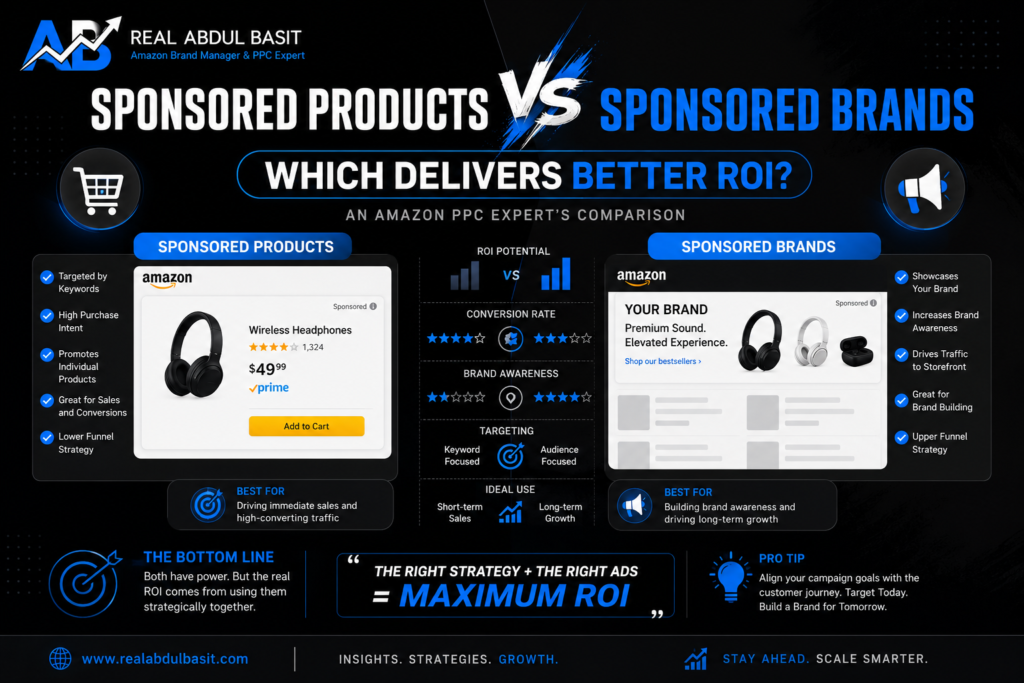
Sponsored Products vs Sponsored Brands: Key Differences
| Feature | Sponsored Products | Sponsored Brands |
|---|---|---|
| Main Goal | Generate Sales | Build Brand Awareness |
| Product Focus | Single Product | Multiple Products |
| Conversion Potential | High | Moderate |
| Brand Visibility | Limited | Strong |
| Setup Complexity | Easy | Moderate |
| Best For | Sales Growth | Brand Growth |
Both formats have value, but they solve different problems.
Which Ad Type Generates More Sales?
For most sellers, Sponsored Products generate more direct sales.
Why?
Because they target shoppers who are already searching for specific products.
These customers often have strong purchase intent.
As a result, Sponsored Products frequently achieve:
- Higher conversion rates
- Lower ACOS
- Better short-term ROI
This makes them the foundation of most Amazon PPC strategies.
Why Sponsored Products Often Deliver Better ROI
ROI depends on profitability.
Since Sponsored Products focus directly on product sales, they usually provide:
- Faster results
- More measurable performance
- Easier optimization
Many sellers see stronger immediate returns compared to Sponsored Brands.
Where Sponsored Brands Excel
Sponsored Brands shine in areas that Sponsored Products cannot fully address.
These include:
Brand Recognition
Customers begin recognizing your brand.
Product Discovery
You can showcase multiple products simultaneously.
Store Traffic
Sponsored Brands often direct shoppers to Amazon Stores.
Cross-Selling Opportunities
Customers may discover products they were not initially searching for.
These benefits contribute to long-term growth.
The Hidden Value of Sponsored Brands
Many sellers evaluate Sponsored Brands only by ACOS.
This can be misleading.
Sponsored Brands often influence:
- Future purchases
- Brand searches
- Repeat customers
- Store visits
Some of these benefits are difficult to measure directly.
However, they still contribute to overall business growth.
ACOS Comparison
In many accounts:
Sponsored Products
- Lower ACOS
- Higher conversion rates
- Strong direct attribution
Sponsored Brands
- Higher ACOS
- Lower direct conversions
- Stronger branding impact
This doesn’t mean Sponsored Brands are less valuable.
It simply means their purpose is different.
Which Ad Type Is Better for New Sellers?
For new Amazon sellers, Sponsored Products are usually the better starting point.
New products need:
- Traffic
- Sales velocity
- Reviews
- Ranking signals
Sponsored Products support all of these goals.
Most successful launches rely heavily on Sponsored Products.
Which Ad Type Is Better for Established Brands?
Established brands often benefit from using both.
As a brand grows, awareness becomes increasingly important.
Sponsored Brands can help:
- Protect branded keywords
- Increase customer loyalty
- Expand product discovery
This makes them valuable for scaling businesses.
How Sponsored Brands Support Organic Growth
Sponsored Brands can indirectly improve:
- Brand searches
- Click-through rates
- Customer familiarity
These factors often contribute to stronger overall performance.
Customers are more likely to buy from brands they recognize.
The Best Strategy: Use Both Together
The highest-performing Amazon advertisers rarely choose one format exclusively.
Instead, they combine both.
Sponsored Products Handle
- Sales generation
- Keyword rankings
- Product launches
- Conversion-focused traffic
Sponsored Brands Handle
- Brand awareness
- Store traffic
- Product discovery
- Long-term positioning
Together, they create a balanced advertising strategy.
Real Seller Example
Consider a supplement brand.
Sponsored Products
Target:
- “Vitamin D3”
- “Immune Support Supplement”
- “Vitamin D Capsules”
Goal:
Generate sales.
Sponsored Brands
Showcase:
- Vitamin D
- Multivitamins
- Fish Oil
Goal:
Build brand awareness and increase average order value.
This combination often delivers stronger results than either format alone.
Common Mistakes Sellers Make
Ignoring Sponsored Brands
Many sellers focus exclusively on direct sales and overlook branding opportunities.
Using Sponsored Brands Too Early
New products often need sales before branding campaigns become effective.
Measuring Everything by ACOS
Brand-focused campaigns require broader evaluation.
Sending Sponsored Brand Traffic to Weak Storefronts
Your Amazon Store should provide a strong customer experience.
How I Allocate PPC Budgets
For many accounts, I typically prioritize:
70–80% Budget
Sponsored Products
20–30% Budget
Sponsored Brands
The exact ratio depends on:
- Product maturity
- Brand strength
- Advertising goals
- Market competition
Related Articles
You may also find these guides helpful:
- Amazon PPC Automation: Is AI Better Than Manual Campaigns?
- TACOS vs ACOS: Which Amazon PPC Metric Actually Matters?
- The Real Difference Between ACOS, TACOS, and ROAS
- 10 Amazon PPC Mistakes That Increase TACOS in 2026
You can also explore our Amazon PPC Management and Amazon Growth Consulting services.
External Resources
For additional learning, review:
- Amazon Ads Learning Console
- Amazon Seller University
- Amazon Advertising Certification Resources
These official resources provide valuable guidance for Amazon advertisers.
Frequently Asked Questions
Are Sponsored Products better than Sponsored Brands?
For direct sales and lower ACOS, Sponsored Products often perform better. However, Sponsored Brands are stronger for brand awareness and long-term growth.
Which ad type has the best ROI?
Sponsored Products usually deliver stronger short-term ROI, while Sponsored Brands often provide additional branding benefits that support future growth.
Can I use Sponsored Brands without Brand Registry?
No. Sponsored Brands generally require enrollment in Amazon Brand Registry.
Should beginners use Sponsored Brands?
Most beginners should focus on Sponsored Products first and add Sponsored Brands as their business grows.
Do Sponsored Brands improve organic rankings?
Indirectly, they can increase visibility, brand awareness, and branded searches, which may contribute to stronger overall performance.
Final Verdict
When comparing Sponsored Products vs Sponsored Brands, the answer isn’t necessarily choosing one over the other.
Sponsored Products typically deliver:
- Better direct ROI
- Lower ACOS
- Higher conversion rates
Sponsored Brands typically deliver:
- Greater brand awareness
- Better customer recognition
- Stronger long-term growth potential
For most Amazon businesses, Sponsored Products should form the foundation of the advertising strategy.
However, Sponsored Brands become increasingly valuable as your brand grows.
In 2026, the advertisers achieving the best results are not asking which format is better.
They’re learning how to use both together strategically.