Building an Amazon Brand That Survives Competition in 2026
Thousands of new sellers launch products on Amazon every day. Unfortunately, many of them disappear within months.
Why?
Because selling products is easy. Building a brand that survives competition is much harder.
In 2026, Amazon has become more competitive than ever. AI tools make product research easier, competitors can launch copycat products faster, and advertising costs continue to rise.
The sellers who thrive aren’t necessarily those with the cheapest products or biggest budgets. They’re the ones who build brands customers trust and remember.
In this guide, I’ll explain how to build an Amazon brand that survives competition, protects profits, and creates long-term growth.
Why Most Amazon Sellers Struggle Against Competition
Many sellers focus only on:
- Finding trending products
- Launching listings quickly
- Running PPC campaigns
- Chasing short-term sales
While these tactics can generate revenue initially, they rarely create sustainable businesses.
Common problems include:
- Price wars
- Rising TACOS
- Lower profit margins
- Copycat competitors
- Weak customer loyalty
Without a brand, customers often choose the cheapest option available.
What Makes an Amazon Brand Competitive?
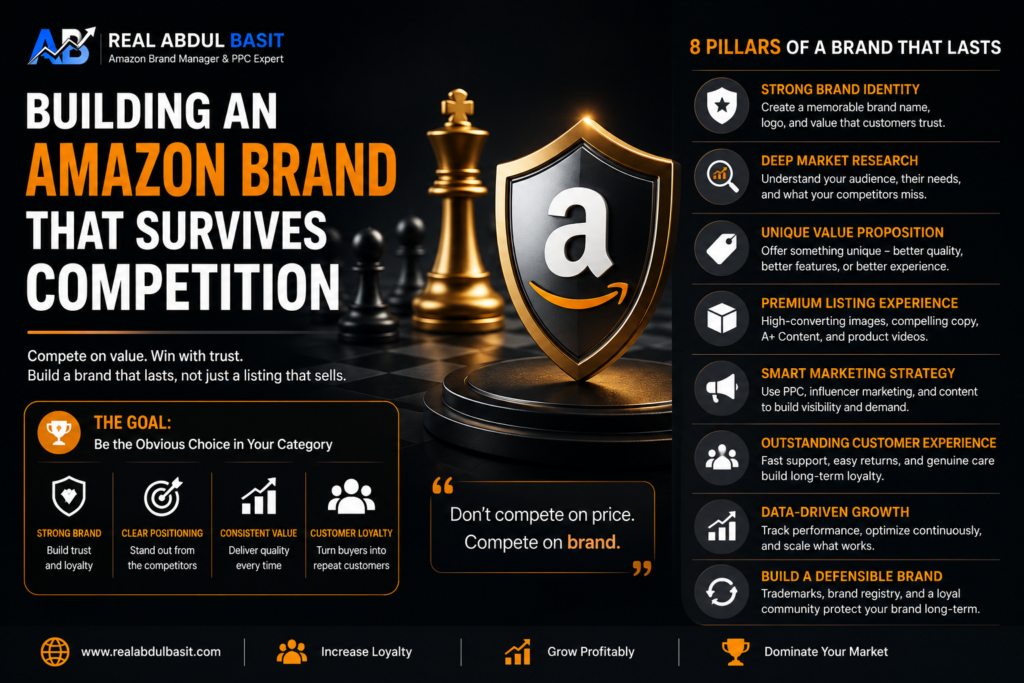
A competitive Amazon brand has something competitors cannot easily copy.
This includes:
- Brand identity
- Customer trust
- Product quality
- Unique positioning
- Consistent experience
Strong brands compete on value, not just price.
Product Seller vs Brand Builder
| Product Seller | Brand Builder |
|---|---|
| Focuses on products | Focuses on customers |
| Competes on price | Competes on value |
| Short-term sales | Long-term growth |
| Generic listings | Strong brand identity |
| Relies heavily on PPC | Builds organic demand |
| Easy to replace | Difficult to replace |
In 2026, the second approach is becoming increasingly important.
Step 1: Define Your Brand Positioning
Before launching products, answer these questions:
Who Is Your Ideal Customer?
Understand:
- Age
- Interests
- Problems
- Buying behavior
The better you understand customers, the easier it becomes to build products they actually want.
What Makes Your Brand Different?
Ask:
Why should someone buy from you instead of competitors?
Examples:
- Better quality
- Better customer support
- Premium design
- Specialized niche focus
Your differentiation becomes your competitive advantage.
Step 2: Build a Professional Brand Identity
Customers judge brands quickly.
Invest in:
Brand Name
Choose a name that is:
- Memorable
- Easy to pronounce
- Relevant to your niche
Logo Design
A professional logo increases credibility and trust.
Product Packaging
Many sellers ignore packaging.
However, packaging affects:
- Customer experience
- Reviews
- Repeat purchases
- Brand recognition
Great packaging creates a lasting impression.
Step 3: Register Your Brand on Amazon
Amazon Brand Registry provides:
- Brand protection
- A+ Content
- Sponsored Brands Ads
- Enhanced analytics
- Storefront creation
These tools help brands compete more effectively.
Step 4: Optimize for Organic Rankings
Advertising alone cannot sustain growth forever.
Long-term success requires strong organic visibility.
Key ranking factors include:
- Keyword relevance
- Conversion rate
- Sales velocity
- Reviews
- Click-through rate
Related Articles:
- How Amazon Organic Ranking Works in 2026
- Why Your Amazon Product Is Not Ranking Organically
Better organic rankings reduce dependence on advertising.
Step 5: Create Better Listings Than Competitors
Most listings look identical.
Stand out with:
High-Quality Images
Show:
- Product benefits
- Features
- Lifestyle usage
- Comparison graphics
Persuasive Copy
Focus on:
- Customer problems
- Solutions
- Outcomes
Avoid simply listing specifications.
A+ Content
A+ Content helps:
- Increase conversions
- Build trust
- Differentiate products
Strong storytelling often wins against lower prices.
Step 6: Build Customer Loyalty
Winning one sale is good.
Winning repeat customers is better.
Focus on:
- Product quality
- Customer satisfaction
- Fast issue resolution
Customers who trust your brand often buy again.
Step 7: Expand Product Lines Strategically
Many sellers launch random products.
Successful brands expand logically.
Example:
Fitness Brand:
- Resistance bands
- Yoga mats
- Foam rollers
- Recovery tools
Each product strengthens the overall brand.
Step 8: Use PPC to Support Branding
Amazon PPC should support brand growth, not just sales.
Use:
Sponsored Products
For visibility and keyword targeting.
Sponsored Brands
To build awareness and showcase multiple products.
Sponsored Display
For retargeting and audience expansion.
Related Articles:
- What Is TACOS in Amazon Advertising?
- TACOS vs ACOS: Which Amazon PPC Metric Actually Matters?
- 10 Amazon PPC Mistakes That Increase TACOS in 2026
A balanced PPC strategy helps brands scale profitably.
Step 9: Leverage AI Without Losing Your Brand Voice
AI tools can help with:
- Keyword research
- Listing creation
- PPC optimization
- Data analysis
However, don’t allow AI to make your brand sound generic.
Use AI for efficiency while maintaining a unique voice.
Related Article:
- AI + Amazon FBA: The Growth Strategy I’m Using Right Now
Common Mistakes That Destroy Amazon Brands
Avoid:
❌ Competing only on price
❌ Ignoring customer feedback
❌ Launching unrelated products
❌ Poor packaging
❌ Weak branding
❌ Overreliance on PPC
❌ Copying competitors
These mistakes often lead to declining profitability.
Benefits of Building a Strong Amazon Brand
Better Customer Trust
Customers buy from brands they recognize.
Higher Conversion Rates
Trust increases purchasing decisions.
More Repeat Purchases
Loyal customers reduce acquisition costs.
Lower Long-Term TACOS
Organic demand reduces advertising dependence.
Greater Business Value
Strong brands become valuable assets.
Real Seller Example
Imagine two sellers launch similar products.
Seller A
- Generic branding
- Heavy PPC reliance
- Constant price discounts
After one year:
- High TACOS
- Shrinking margins
- Strong competition
Seller B
- Professional branding
- Better customer experience
- Consistent messaging
After one year:
- Better reviews
- More organic traffic
- Higher customer loyalty
- Stronger profits
This is the power of branding.
Frequently Asked Questions
Why is branding important on Amazon?
Branding helps sellers differentiate themselves, build trust, and reduce dependency on price competition.
Can small Amazon sellers build strong brands?
Yes. Many successful brands started with a single product and expanded over time.
Does branding improve Amazon rankings?
Indirectly, yes. Strong brands often generate better conversions, reviews, and repeat purchases.
Is Amazon Brand Registry worth it?
Absolutely. It provides valuable tools for protecting and growing your brand.
How long does it take to build an Amazon brand?
Brand building is a long-term process, but consistent effort can create significant advantages within 6–12 months.
Related Articles
Continue Learning:
- Product Branding vs Product Selling on Amazon
- How to Build a Brand on Amazon Instead of Just Selling Products
- Amazon Organic Ranking vs Sponsored Ranking Explained
- The Real Difference Between ACOS, TACOS, and ROAS
- Amazon FBA AI Tools Every Seller Should Know
Need help growing your Amazon business?
👉 Contact Me:
https://realabdulbasit.com/contact/
External Resources
- Amazon Brand Registry
- Amazon Seller University
- Amazon Advertising Learning Console
Final Verdict
Competition on Amazon will continue increasing in 2026 and beyond.
Sellers focused only on products often struggle when competitors lower prices or copy their listings.
Brands, however, create advantages that are difficult to replicate:
- Trust
- Loyalty
- Recognition
- Repeat purchases
- Sustainable growth
If your goal is to build a business that survives market changes and increasing competition, focus on creating a brand—not just selling products.
That’s where the biggest Amazon opportunities exist today.