TACoS Explained: The Amazon PPC Metric Every Seller Should Track
If you’re running Amazon PPC campaigns, you’ve probably come across the term TACoS. While many sellers focus only on ACoS, experienced Amazon brands know that TACoS (Total Advertising Cost of Sales) is one of the most valuable metrics for measuring long-term business growth.
A campaign can have an excellent ACoS but still fail to grow your business. On the other hand, a campaign with a higher ACoS can be profitable if it increases your organic sales and lowers your TACoS over time.
Understanding TACoS helps you see the bigger picture instead of judging your advertising performance based on ad sales alone.
In this guide, I’ll explain what TACoS is, how to calculate it, why it matters, and how you can use it to build a more profitable Amazon business in 2026.
What Is TACoS?
TACoS stands for Total Advertising Cost of Sales.
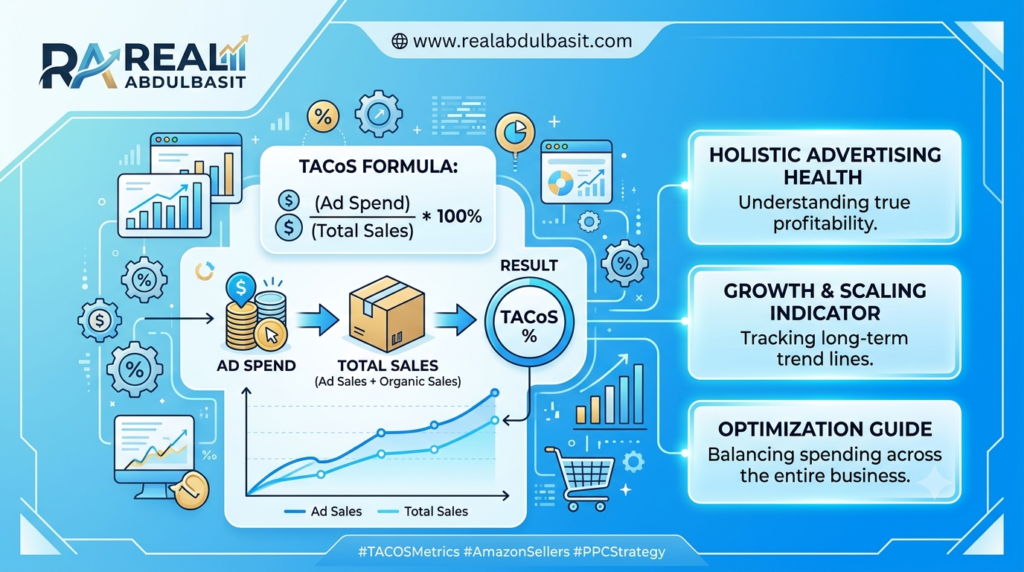
It measures how much you spend on advertising compared to your total Amazon sales, including both advertising sales and organic sales.
Unlike ACoS, which only looks at revenue generated directly from ads, TACoS measures the overall impact of your advertising on your business.
TACoS Formula
The formula is simple:
TACoS = (Ad Spend ÷ Total Sales) × 100
Example
Suppose:
- Ad Spend: $600
- Total Sales: $10,000
Calculation:
($600 ÷ $10,000) × 100 = 6%
Your TACoS is 6%.
This means you spent six cents on advertising for every dollar of total revenue.
Why TACoS Matters
Many Amazon sellers monitor only ACoS.
That can be misleading.
Imagine two businesses.
Seller A
- ACoS: 18%
- TACoS: 20%
Most of their sales come from advertising.
Seller B
- ACoS: 28%
- TACoS: 8%
Although the ACoS is higher, organic sales are much stronger.
Seller B is building a healthier business because advertising is supporting long-term growth instead of creating dependency.
TACoS vs ACoS
| Metric | TACoS | ACoS |
|---|---|---|
| Measures | Overall business performance | Advertising performance |
| Includes Organic Sales | ✅ Yes | ❌ No |
| Includes Ad Sales | ✅ Yes | ✅ Yes |
| Best For | Long-term growth | Campaign optimization |
| Primary Goal | Reduce dependency on ads | Improve PPC efficiency |
Both metrics are important, but they answer different questions.
What Is a Good TACoS?
The ideal TACoS depends on:
- Product category
- Profit margins
- Product lifecycle
- Business goals
General benchmarks:
| TACoS | Performance |
|---|---|
| Below 5% | Excellent |
| 5–10% | Very Good |
| 10–15% | Healthy |
| 15–20% | Needs Improvement |
| Above 20% | Often Too High |
A new product may have a higher TACoS during launch while building visibility.
Why TACoS Usually Decreases Over Time
Successful Amazon businesses often experience declining TACoS.
Here’s why:
Advertising increases visibility.
↓
Visibility generates more sales.
↓
Sales improve keyword rankings.
↓
Organic rankings improve.
↓
Organic sales increase.
↓
Dependence on advertising decreases.
A declining TACoS usually indicates that your Amazon SEO and PPC strategies are working together.
Factors That Influence TACoS
Several factors affect your TACoS.
Product Listing Quality
Better listings convert more visitors into buyers.
Improve:
- Product title
- Images
- Bullet points
- Product description
- A+ Content
Higher conversion rates often lead to stronger organic rankings.
Amazon PPC Optimization
Optimize campaigns by:
- Adding negative keywords
- Adjusting bids
- Improving targeting
- Eliminating wasted spend
Efficient campaigns contribute to healthier TACoS.
Organic Rankings
The higher your product ranks organically, the less you rely on paid traffic.
Focus on:
- Amazon SEO
- Customer experience
- Reviews
- Sales velocity
Organic growth naturally lowers TACoS.
Customer Reviews
Products with strong ratings typically convert better.
Higher conversion rates improve:
- Organic rankings
- Advertising efficiency
- Overall profitability
Brand Strength
Established brands often receive:
- Branded searches
- Repeat customers
- Higher trust
- Better conversion rates
Strong brands generally maintain lower TACoS over time.
How to Reduce TACoS
1. Improve Your Product Listings
A better listing converts more shoppers.
Optimize:
- Main image
- Product title
- Bullet points
- Product description
- A+ Content
2. Increase Organic Traffic
Invest in:
- Amazon SEO
- High-quality content
- Better customer experience
The more organic sales you generate, the lower your TACoS becomes.
3. Optimize PPC Campaigns
Review campaigns every week.
Pause keywords that consistently lose money.
Increase bids on profitable search terms.
Monitor:
- CTR
- Conversion Rate
- ACoS
- ROAS
4. Build a Strong Brand
Customers trust recognizable brands.
Brand loyalty creates:
- Repeat purchases
- Better reviews
- Higher lifetime value
These factors reduce long-term advertising costs.
5. Use AI Tools
AI can help analyze:
- PPC performance
- Keyword opportunities
- Competitor data
- Inventory trends
Better insights lead to smarter decisions.
Common TACoS Mistakes
Avoid these mistakes:
❌ Tracking only ACoS
❌ Ignoring organic growth
❌ Chasing the lowest ACoS
❌ Neglecting Amazon SEO
❌ Poor keyword targeting
❌ Weak product listings
❌ Failing to monitor long-term trends
Always evaluate advertising within the context of your entire business.
Benefits of Monitoring TACoS
Tracking TACoS helps you:
- Measure overall profitability
- Understand advertising efficiency
- Monitor organic growth
- Improve budgeting decisions
- Scale campaigns more confidently
It’s one of the most valuable metrics for long-term Amazon success.
Frequently Asked Questions
What does TACoS stand for?
TACoS stands for Total Advertising Cost of Sales. It measures advertising spend as a percentage of total Amazon sales.
Is TACoS better than ACoS?
Neither metric is better. ACoS measures campaign efficiency, while TACoS measures overall business performance. Successful sellers track both.
What is a healthy TACoS?
For many established brands, a TACoS between 5% and 10% is considered healthy. However, acceptable values vary by category and business goals.
Why is my TACoS increasing?
An increasing TACoS may indicate declining organic sales, inefficient PPC campaigns, lower conversion rates, or increased competition.
How often should I review TACoS?
Review TACoS weekly and monthly to identify long-term trends rather than focusing only on daily changes.
Related Articles
Continue Learning:
- TACoS vs ACoS: Which Amazon Metric Matters More?
- What Is TACoS in Amazon Advertising? Complete Beginner Guide
- The Real Difference Between ACoS, TACoS, and ROAS
- 10 Amazon PPC Mistakes That Increase TACoS
- How Amazon Organic Ranking Works in 2026
- Why Your Amazon Product Is Not Ranking Organically
External Resources
- Amazon Advertising Learning Console
- Amazon Seller University
- Amazon Ads Help Center
Need Help Improving Your Amazon PPC Performance?
Whether you’re launching a new product or scaling an established brand, optimizing TACoS can improve profitability and reduce wasted ad spend.
👉 Contact Me:
https://realabdulbasit.com/contact/
Final Verdict
TACoS is more than just another Amazon advertising metric.
It shows whether your PPC investment is helping your entire business grow—not just generating short-term ad sales.
The best Amazon sellers don’t try to achieve the lowest possible ACoS. Instead, they focus on building strong organic rankings, improving conversion rates, and creating brands that become less dependent on paid advertising over time.
If you want sustainable growth in 2026, make TACoS one of the most important metrics in your Amazon PPC strategy.