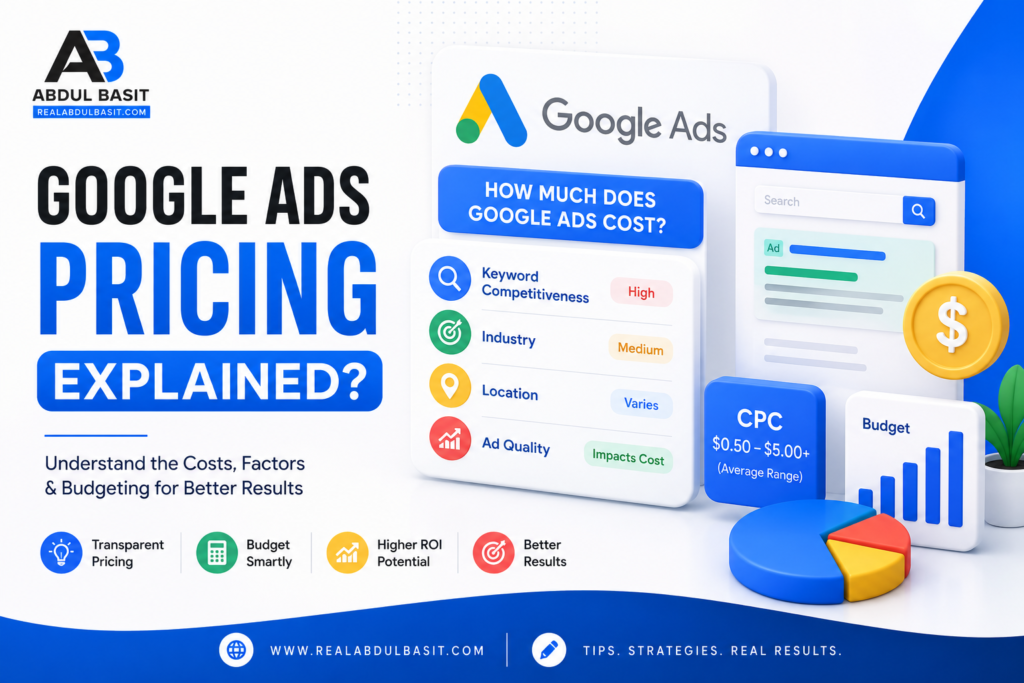
One of the biggest misconceptions about Google Ads is that you need a huge budget to compete.
The truth is, your budget should match your business goals, industry, and expected return on investment (ROI).
For example:
- A local plumbing company may start with $20–$50 per day.
- An ecommerce store might spend $100–$500 per day.
- A national law firm could invest thousands of dollars daily because one new client may be worth several thousand dollars.
Instead of asking, “How much should I spend?”, ask:
“How much can I invest to acquire one profitable customer?”
That’s the mindset successful advertisers use.
Google Ads Pricing by Campaign Type
Not every Google Ads campaign costs the same.
Here’s how pricing typically differs across campaign types.
| Campaign Type | Typical Pricing Model | Best For |
|---|---|---|
| Search Ads | CPC | Leads and sales |
| Display Ads | CPC / CPM | Brand awareness |
| Shopping Ads | CPC | Ecommerce |
| Performance Max | CPC / Smart Bidding | Multi-channel campaigns |
| Video Ads | CPV | Brand awareness |
| App Campaigns | CPI / CPA | Mobile app installs |
Choose the campaign type based on your marketing objective rather than the lowest cost.
What Makes Google Ads Expensive?
Several factors can increase your advertising costs.
1. Highly Competitive Keywords
Industries such as:
- Insurance
- Legal services
- Finance
- Real estate
- Healthcare
often have some of the highest CPCs because customer value is extremely high.
2. Poor Quality Score
A low Quality Score increases your CPC.
Google rewards advertisers who create relevant ads and landing pages.
Improve your Quality Score by:
- Writing better ad copy
- Using relevant keywords
- Creating fast landing pages
- Improving user experience
3. Weak Landing Pages
Many advertisers blame Google Ads when their landing page is the real problem.
Your landing page should:
- Load quickly
- Be mobile-friendly
- Match the ad message
- Include a clear call-to-action
- Build trust with testimonials or reviews
Better landing pages often reduce advertising costs while increasing conversions.
4. Broad Keyword Targeting
Broad keywords attract irrelevant traffic.
Instead, focus on:
- Exact Match
- Phrase Match
- Long-tail keywords
This improves conversion rates and reduces wasted clicks.
How to Reduce Google Ads Costs
Reducing costs doesn’t mean lowering your budget.
It means improving efficiency.
Here are practical strategies:
Improve Quality Score
Higher Quality Scores generally lead to lower CPCs.
Add Negative Keywords
Prevent your ads from appearing for irrelevant searches.
Target Buyer Intent
Focus on keywords that indicate someone is ready to purchase.
Test Multiple Ads
Create several versions of your ads.
Compare:
- Headlines
- Descriptions
- Calls-to-action
Then keep the best-performing versions.
Optimize Landing Pages
A better landing page often produces more conversions without increasing ad spend.
Review Search Terms Regularly
Identify keywords wasting money and remove them.
Is Google Ads Worth the Cost?
For many businesses, yes.
Google Ads gives you access to people actively searching for products or services.
Unlike many other advertising platforms, users often have strong purchase intent.
For example:
If someone searches for:
“Emergency plumber near me”
they’re likely looking for immediate help.
That intent often leads to higher conversion rates.
When campaigns are managed properly, Google Ads can deliver an excellent return on investment.
Google Ads vs Facebook Ads Pricing
Many businesses compare Google Ads with Meta Ads.
Here’s a simple comparison.
| Feature | Google Ads | Facebook Ads |
|---|---|---|
| User Intent | High | Medium |
| Pricing Model | CPC, CPM, CPA | CPC, CPM |
| Best For | Search demand | Demand generation |
| Conversion Potential | Very High | High |
| Learning Curve | Moderate | Moderate |
Google Ads captures existing demand.
Facebook Ads create demand.
Many successful businesses use both together.
Common Google Ads Pricing Mistakes
Avoid these costly mistakes:
❌ Choosing broad keywords only
❌ Ignoring Quality Score
❌ Sending traffic to poor landing pages
❌ Not tracking conversions
❌ Using one ad for every keyword
❌ Never reviewing search terms
❌ Setting unrealistic budgets
Small improvements often produce large savings.
Google Ads Pricing Example
Imagine you’re selling running shoes online.
Monthly Budget:
$1,000
Average CPC:
$1.50
Estimated Clicks:
Approximately 667
Landing Page Conversion Rate:
5%
Estimated Sales:
33
Average Profit Per Sale:
$70
Estimated Profit:
$2,310
Advertising Spend:
$1,000
Estimated Net Profit Before Other Expenses:
$1,310
This example shows why ROI matters more than CPC alone.
Frequently Asked Questions
How much does Google Ads cost per click?
Google Ads CPC varies by industry, competition, and keyword. Some clicks cost less than $1, while competitive industries may pay $20 or more per click.
Can I run Google Ads with a small budget?
Yes. Many local businesses begin with as little as $10–$20 per day and scale as they see positive results.
Does Google charge monthly?
No. Google Ads typically charges based on your billing settings, which may include automatic payments after reaching a billing threshold or on a monthly cycle.
Is Google Ads better than Facebook Ads?
It depends on your goals. Google Ads targets people actively searching for solutions, while Facebook Ads help create awareness and reach new audiences.
Why are my Google Ads so expensive?
High competition, low Quality Score, poor landing pages, and broad keyword targeting are common reasons for higher costs.
Related Articles
Continue Learning:
- Google Search Ads vs Display Ads
- Meta Ads vs Google Ads: Which Is Better for Beginners?
- Why Most Businesses Fail at Digital Marketing
- My Step-by-Step Marketing Strategy for Online Growth
- How to Scale Meta Ads Without Increasing CPA
External Resources
- Google Ads Help Center
- Google Ads Keyword Planner
- Google Analytics Help
- Google Skillshop
Need Help Running Profitable Google Ads?
Whether you’re launching your first campaign or scaling an existing business, the right strategy can lower costs and improve results.
👉 Contact me:
Final Verdict
Google Ads pricing isn’t fixed. Your costs depend on the keywords you target, your industry, your Quality Score, and how well your campaigns are optimized.
Instead of focusing only on cost per click, pay attention to return on investment. A higher CPC can still be profitable if it brings qualified customers who convert into paying clients.
Successful advertisers continuously optimize keywords, improve landing pages, write better ads, and monitor campaign performance. Over time, these improvements reduce wasted spend and increase profitability.
If you’re serious about growing your business online in 2026, understanding how Google Ads pricing works is one of the smartest investments you can make.
Google Ads isn’t about spending more—it’s about spending smarter.