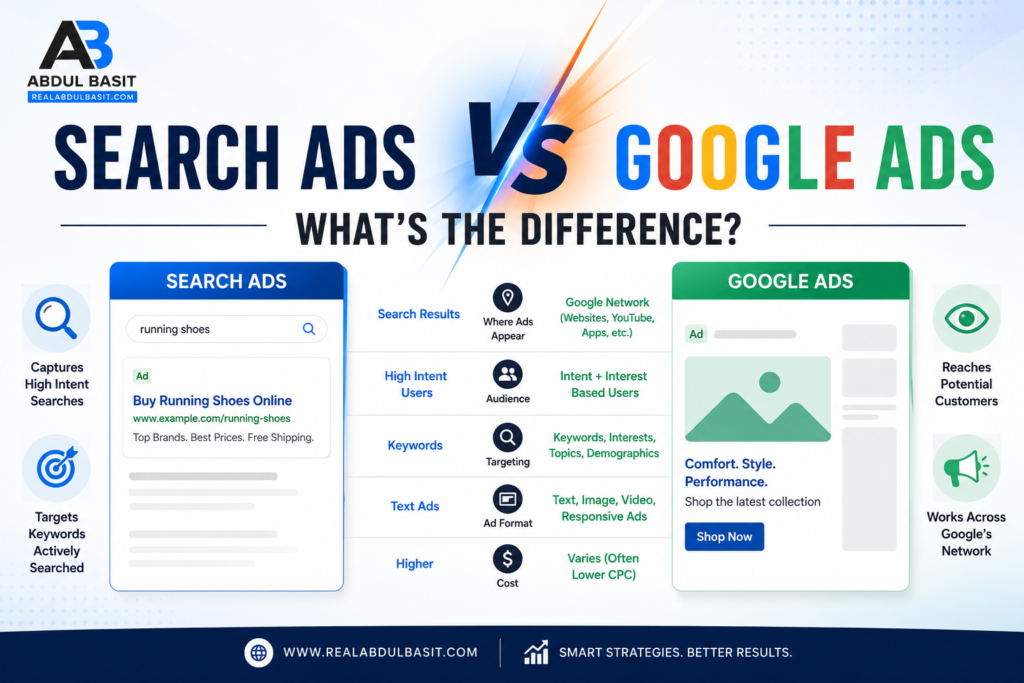
Search Ads vs Google Ads: What’s the Difference?
If you’re new to online advertising, you’ve probably heard terms like Search Ads, Google Ads, Display Ads, and Shopping Ads used interchangeably. This often creates confusion for business owners and marketers.
Many people search for Search Ads vs Google Ads because they assume they are two completely different advertising platforms. In reality, Search Ads are one type of campaign that runs inside the Google Ads platform.
Understanding this distinction is important because choosing the wrong campaign type can waste your advertising budget and reduce your return on investment (ROI).
Whether you’re promoting an ecommerce store, generating leads, or growing your local business, selecting the right Google advertising campaign is one of the most important decisions you’ll make.
In this complete guide, I’ll explain the difference between Search Ads and Google Ads, compare every major campaign type, discuss when each works best, and help you decide which option fits your marketing goals.
What Are Google Ads?
Google Ads is Google’s online advertising platform that allows businesses to promote their products and services across Google’s entire advertising network.
Google Ads includes several campaign types, including:
- Google Search Ads
- Google Display Ads
- Shopping Ads
- Video Ads (YouTube)
- Performance Max
- App Campaigns
- Demand Gen Campaigns
In other words, Google Search Ads are only one part of Google Ads.
Think of Google Ads as the umbrella platform, while Search Ads are one advertising option within that platform.
What Are Search Ads?
Search Ads are text-based advertisements that appear on Google Search results when users search for specific keywords.
For example, someone searching:
“Best running shoes”
may see sponsored listings at the top of Google’s search results before the organic listings.
These are Google Search Ads.
Unlike other advertising formats, Search Ads target users who already have buying intent.
They’re actively looking for information, products, or services.
This is why Search Ads often generate some of the highest conversion rates among digital advertising channels.
Search Ads vs Google Ads
Now let’s answer the most common question.
Search Ads vs Google Ads
Many beginners think Search Ads and Google Ads are competitors.
They are not.
Here’s the difference.
| Feature | Search Ads | Google Ads |
|---|---|---|
| Platform | Google Search | Entire Google Advertising Platform |
| Ad Format | Text Ads | Search, Display, Shopping, Video, Apps & More |
| Appears On | Google Search Results | Google Search, YouTube, Gmail, Display Network, Discover and Partner Sites |
| Best For | High Purchase Intent | Multiple Marketing Objectives |
| Target Audience | Active Searchers | Searchers + Browsers |
Simply put:
Every Search Ad is a Google Ad.
But not every Google Ad is a Search Ad.
This is one of the biggest misunderstandings among new advertisers.
Google Search Ads vs Google Display Ads
One of the most important comparisons is Google Search Ads vs Google Display Ads.
Although both use the Google Ads platform, they work very differently.
Google Search Ads
Search Ads appear when users actively search for something.
Example:
Someone searches:
“Digital marketing agency near me.”
Your ad appears.
The user already wants a solution.
This is called high intent marketing.
Google Display Ads
Display Ads appear while people browse websites, read blogs, check the news, or watch videos.
Users are not necessarily searching for your product.
Instead, Google displays image or banner ads based on audience targeting and browsing behavior.
This makes Display Ads ideal for:
- Brand awareness
- Remarketing
- Audience building
- Visual advertising
Display Ads vs Search Ads
The debate around Display Ads vs Search Ads depends on your marketing objectives.
| Search Ads | Display Ads |
|---|---|
| High buying intent | Lower buying intent |
| Text-based | Image and banner ads |
| Higher conversion rates | Higher reach |
| Better for leads | Better for awareness |
| Keyword targeting | Audience targeting |
If your goal is immediate sales, Search Ads usually perform better.
If your goal is building brand awareness, Display Ads are often the stronger choice.
Google Display Ads vs Search Ads: Which Converts Better?
When comparing Google Display Ads vs Search Ads, conversion rates are often the deciding factor.
Search Ads typically convert better because users are already looking for your product or service.
For example:
Someone searching:
“Buy office chair online”
is much closer to making a purchase than someone casually browsing a news website.
Display Ads, however, excel at introducing your brand to new audiences.
This makes both campaign types valuable when used together.
Google Display Ads for Lead Generation
Many businesses ask whether Google Display Ads for lead generation actually work.
The answer is yes—but only when used strategically.
Display campaigns perform well for lead generation when combined with:
- Strong landing pages
- Attractive visual creatives
- Remarketing campaigns
- Lead magnets
- Free consultations
- Ebook downloads
- Webinar registrations
Display Ads rarely outperform Search Ads for direct lead generation, but they can significantly increase brand recognition and nurture potential customers before they convert.
Google AdWords vs Display Ads
Although many marketers still search for Google AdWords vs Display Ads, it’s important to understand that Google AdWords was renamed Google Ads in 2018.
Today, Display Ads are simply one campaign type inside Google Ads.
The comparison is essentially:
Google Ads Platform
vs
Google Display Campaigns
Understanding this terminology helps avoid confusion when reading older marketing guides or watching outdated tutorials.
Why Businesses Choose Search Ads
Search Ads remain one of the most effective forms of digital advertising because they target customers with clear purchase intent.
Businesses often choose Search Ads to:
- Generate leads
- Increase online sales
- Book appointments
- Drive phone calls
- Promote local services
- Capture high-intent traffic
If your customers already know what they’re looking for, Search Ads are often the best place to start.
Why Businesses Choose Display Ads
Display Ads help businesses reach potential customers before they begin searching.
They are commonly used to:
- Increase brand awareness
- Reach new audiences
- Promote product launches
- Stay visible through remarketing
- Build trust over time
Although Display Ads generally have lower click-through and conversion rates than Search Ads, they can play a valuable role in a full-funnel marketing strategy.
Display Ads vs Shopping Ads
Another comparison many advertisers make is Display Ads vs Shopping Ads. While both campaign types are available in Google Ads, they serve different purposes.
Display Ads
Display Ads use images, banners, and responsive creatives to capture attention while users browse websites, apps, and YouTube.
They’re ideal for:
- Brand awareness
- Remarketing
- Audience expansion
- Product launches
Shopping Ads
Shopping Ads display:
- Product image
- Product title
- Price
- Store name
- Ratings (when available)
They appear directly in Google Shopping results and often at the top of Google Search.
Shopping Ads work exceptionally well for ecommerce businesses because shoppers can see product details before clicking.
Display Ads vs Shopping Ads: Which Performs Better?
| Display Ads | Shopping Ads |
|---|---|
| Best for brand awareness | Best for ecommerce sales |
| Visual banner ads | Product listing ads |
| Audience targeting | Product feed targeting |
| Lower purchase intent | Higher purchase intent |
| Great for remarketing | Great for ready-to-buy customers |
If you own an ecommerce store, Shopping Ads generally generate higher conversion rates because shoppers already know what they want.
Google Ads vs Meta Ads
One of the most searched comparisons today is Google Ads vs Meta Ads.
Although both platforms can generate excellent results, they work very differently.
Google Ads
Google captures existing demand.
People search because they already need something.
Examples:
- Buy laptop
- Best dentist near me
- Amazon PPC Agency
The customer already has buying intent.
Meta Ads
Meta Ads (Facebook and Instagram) create demand.
Instead of waiting for customers to search, Meta shows advertisements based on user interests, demographics, and behaviors.
People may discover products they weren’t actively looking for.
This makes Meta ideal for:
- Brand awareness
- Visual storytelling
- New product launches
- Audience building
Google Ads vs Meta Ads Comparison
| Google Ads | Meta Ads |
|---|---|
| Captures search intent | Creates demand |
| Keyword targeting | Interest targeting |
| Higher purchase intent | Higher discovery potential |
| Excellent for local services | Excellent for ecommerce brands |
| Search-driven | Social-driven |
Many successful businesses don’t choose one over the other—they combine both platforms for maximum growth.
Which Campaign Type Delivers the Best ROI?
There isn’t a single answer.
It depends on your goals.
Choose Search Ads if you want:
- Phone calls
- Qualified leads
- Service inquiries
- Local customers
- High conversion rates
Choose Display Ads if you want:
- Brand awareness
- Remarketing
- Product visibility
- Audience growth
Choose Shopping Ads if you want:
- Ecommerce sales
- Product visibility
- Better product discovery
- Higher purchase intent
Choose Meta Ads if you want:
- Build brand awareness
- Generate engagement
- Promote visual products
- Scale social commerce
Cost Comparison
Average advertising costs vary by industry, competition, and targeting.
Here’s a general comparison.
| Campaign | Typical Pricing |
|---|---|
| Search Ads | Higher CPC |
| Display Ads | Lower CPC and CPM |
| Shopping Ads | Medium CPC |
| Meta Ads | Lower CPM, competitive CPC |
Remember, the cheapest click doesn’t always produce the best return.
A $5 click that generates a $500 sale is far more valuable than a $0.50 click that never converts.
Always evaluate campaigns based on ROI rather than CPC alone.
Which Businesses Should Use Search Ads?
Search Ads work particularly well for:
- Local businesses
- Lawyers
- Doctors
- Dentists
- Marketing agencies
- Software companies
- Home services
- B2B businesses
These businesses benefit from customers actively searching for solutions.
Which Businesses Should Use Display Ads?
Display campaigns perform well for:
- Ecommerce brands
- New startups
- SaaS companies
- Online courses
- Brand awareness campaigns
- Product launches
Display Ads help businesses stay visible throughout the customer journey.
Which Businesses Should Use Shopping Ads?
Shopping campaigns are designed primarily for ecommerce.
Examples include:
- Fashion stores
- Electronics retailers
- Furniture brands
- Beauty products
- Home goods
- Sports equipment
Because customers can see product images and prices before clicking, Shopping Ads often generate highly qualified traffic.
Common Mistakes Businesses Make
Avoid these common advertising mistakes.
❌ Running Display Ads when immediate leads are needed
❌ Ignoring Search Ads for high-intent keywords
❌ Using poor landing pages
❌ Targeting broad audiences without testing
❌ Not tracking conversions
❌ Failing to install remarketing tags
❌ Choosing the wrong campaign objective
❌ Optimizing only for clicks instead of conversions
Success comes from matching the campaign type to your business goals.
Expert Tips for Better Results
Whether you’re using Search, Display, Shopping, or Meta Ads, these best practices can improve performance:
- Research keywords thoroughly.
- Write compelling ad copy.
- Use high-quality images.
- Test multiple headlines.
- Optimize landing pages.
- Monitor Quality Score.
- Add negative keywords.
- Review campaign data regularly.
- Focus on conversions, not just traffic.
Small improvements can significantly increase your return on investment over time.
Frequently Asked Questions
What is the difference between Search Ads and Google Ads?
Google Ads is the complete advertising platform, while Search Ads are one campaign type within Google Ads that displays text ads in Google Search results.
Which is better: Search Ads or Display Ads?
Search Ads are generally better for generating leads and sales because they target users with high purchase intent. Display Ads are better for brand awareness and remarketing.
Are Shopping Ads better than Display Ads?
For ecommerce businesses, Shopping Ads often perform better because they show product images, prices, and other details directly in search results.
Should I use Google Ads or Meta Ads?
It depends on your goals. Google Ads captures existing demand, while Meta Ads help create demand and build brand awareness. Many businesses use both together.
Can I run Search, Display, and Shopping campaigns at the same time?
Yes. Combining multiple campaign types allows you to reach customers at different stages of the buying journey.
Related Articles
Continue Learning:
- Google Search Ads vs Display Ads
- Meta Ads vs Google Ads: Which Is Better for Beginners?
- Facebook Lead Generation Ads Guide
- Google Search Ads vs Display Ads
- How to Scale Meta Ads Without Increasing CPA
- Why Facebook Ads Fail for Most Businesses
External Resources
- Google Ads Help Center
- Google Ads Keyword Planner
- Google Merchant Center
- Google Skillshop
- Meta Business Help Center
Need Help Choosing the Right Advertising Strategy?
Whether you’re launching your first campaign or scaling an established business, choosing the right ad platform can dramatically improve your results.
👉 Contact Me:
https://realabdulbasit.com/contact/
Final Verdict
Understanding the difference between Search Ads vs Google Ads helps you make smarter marketing decisions.
Search Ads are one of the most effective campaign types within the Google Ads platform because they target users who are actively searching for products or services. However, Search Ads aren’t always the right choice for every business.
Display Ads excel at brand awareness, Shopping Ads dominate ecommerce, and Meta Ads are powerful for audience discovery and engagement.
Rather than asking which platform is “better,” ask which one best supports your business objectives. The most successful advertisers build a strategy that combines multiple campaign types, measures performance consistently, and optimizes based on real data—not assumptions.
When you understand how each campaign works and when to use it, you’ll spend your budget more efficiently, attract higher-quality customers, and achieve stronger long-term results.