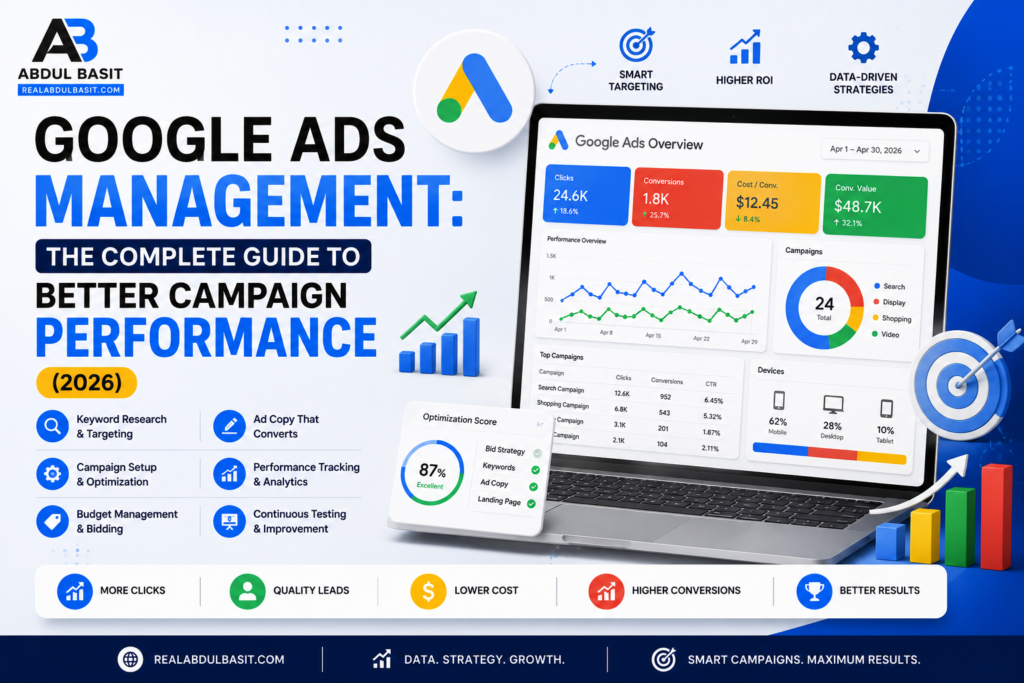
What Is Google Ads Management?
Google Ads Management is the process of planning, creating, monitoring, optimizing, and scaling Google Ads campaigns to generate qualified traffic, leads, and sales while minimizing advertising costs. It involves much more than simply launching an advertisement. Successful Google Ads management requires continuous optimization, keyword research, audience targeting, bid adjustments, conversion tracking, and performance analysis.
Businesses that invest in proper campaign management usually achieve higher click-through rates (CTR), lower cost per click (CPC), better Quality Scores, and stronger return on investment (ROI).
Whether you’re a small business, eCommerce brand, local service provider, or enterprise company, Google Ads can help you reach customers who are actively searching for your products or services.
Why Google Ads Management Matters
Millions of searches happen on Google every day. Every search represents an opportunity to connect with someone looking for exactly what your business offers.
However, simply running ads isn’t enough. Poorly managed campaigns often waste thousands of dollars on irrelevant clicks, low-quality traffic, and underperforming keywords.
Professional Google Ads management helps businesses:
- Reach customers with strong buying intent
- Increase qualified website traffic
- Generate more leads and sales
- Improve conversion rates
- Lower advertising costs
- Maximize Return on Ad Spend (ROAS)
- Make smarter data-driven decisions
Instead of guessing what works, advertisers can optimize campaigns using real performance data.
Key Components of Google Ads Management
Successful campaign management involves several important steps.
Keyword Research
Keyword research forms the foundation of every successful campaign.
Focus on keywords that demonstrate strong commercial intent. Long-tail keywords often convert better because they match specific customer needs while facing less competition.
Examples include:
- Google Ads Management Services
- Google Ads Management Company
- Google Ads Campaign Management
- Google Ads Expert
- Google Ads Consultant
Using a combination of broad, phrase, and exact match keywords helps maximize reach while maintaining control over search relevance.
Campaign Structure
A well-organized account improves Quality Score and simplifies optimization.
Organize campaigns by:
- Products
- Services
- Business goals
- Geographic locations
- Customer segments
Within each campaign, create tightly themed ad groups targeting closely related keywords.
This structure improves ad relevance and increases click-through rates.
Writing High-Converting Ads
Compelling ad copy encourages users to click.
Effective Google Ads typically include:
- Target keyword in the headline
- Clear value proposition
- Strong call-to-action
- Unique selling points
- Trust signals
- Promotional offers when appropriate
Always create multiple ad variations and allow Google to identify top-performing combinations through Responsive Search Ads.
Landing Page Optimization
Even the best advertisement cannot compensate for a poor landing page.
Your landing page should:
- Match search intent
- Load quickly
- Display well on mobile devices
- Include a clear headline
- Highlight customer benefits
- Build trust using testimonials
- Feature a prominent call-to-action
Improving landing page experience often increases conversion rates while lowering advertising costs.
Google Ads Bidding Strategies
Google offers several bidding options depending on your campaign objectives.
Popular strategies include:
- Maximize Conversions
- Target CPA
- Target ROAS
- Maximize Clicks
- Manual CPC
- Enhanced CPC
Artificial Intelligence now powers many Smart Bidding strategies, helping advertisers adjust bids based on user behavior, device, location, and historical conversion data.
However, Smart Bidding still requires ongoing monitoring to achieve optimal performance.
Conversion Tracking
Without conversion tracking, it’s impossible to measure campaign success accurately.
Businesses should track:
- Contact form submissions
- Phone calls
- Online purchases
- Newsletter sign-ups
- Quote requests
- Downloads
- Appointment bookings
Google Ads combined with Google Analytics provides valuable insights into customer behavior throughout the buying journey.
Common Google Ads Management Mistakes
Many businesses struggle because they repeat the same mistakes.
Avoid:
- Targeting overly broad keywords
- Ignoring negative keywords
- Sending traffic to the homepage instead of relevant landing pages
- Not tracking conversions
- Writing weak ad copy
- Failing to optimize campaigns regularly
- Ignoring mobile users
- Setting unrealistic budgets
- Never testing new ad variations
Correcting these issues often leads to immediate performance improvements.
Best Practices for Google Ads Management in 2026
To stay competitive, businesses should adopt modern optimization strategies.
Recommended best practices include:
- Perform weekly account audits.
- Monitor Quality Score regularly.
- Use audience signals and remarketing.
- Test multiple ad headlines and descriptions.
- Improve landing page speed.
- Add relevant ad extensions.
- Analyze search term reports.
- Pause low-performing keywords.
- Increase budgets only after campaigns become profitable.
- Continuously test and refine campaigns.
Google Ads is not a “set it and forget it” platform. Ongoing optimization is the key to long-term success.
Frequently Asked Questions
What is Google Ads Management?
Google Ads Management is the ongoing process of creating, optimizing, monitoring, and improving advertising campaigns to generate better business results while controlling advertising costs.
Is Google Ads worth it?
Yes. When campaigns are properly managed, Google Ads delivers highly targeted traffic, measurable results, and one of the fastest ways to generate qualified leads online.
How often should Google Ads campaigns be optimized?
Campaigns should be reviewed at least once a week. Larger accounts may require daily monitoring to adjust bids, budgets, keywords, and ad performance.
What is the biggest mistake businesses make?
The biggest mistake is launching campaigns without proper keyword research, conversion tracking, or ongoing optimization.
Final Verdict
Google Ads Management is one of the most valuable digital marketing skills for businesses looking to increase online visibility, generate qualified leads, and maximize revenue. Success doesn’t come from spending more money—it comes from building well-structured campaigns, targeting the right audience, optimizing continuously, and making data-driven decisions.
Whether you manage campaigns yourself or work with a Google Ads specialist, consistent optimization will always outperform a “set and forget” approach. By following the strategies outlined in this guide, businesses can improve campaign performance, lower advertising costs, and achieve sustainable growth throughout 2026 and beyond.
Suggested Internal Links
- Google Ads Pricing Explained
- Google Search Ads vs Display Ads
- Search Ads vs Google Ads: What’s the Difference?
- Meta Ads vs Google Ads: Which Is Better for Beginners?
- How to Scale Meta Ads Without Increasing CPA?