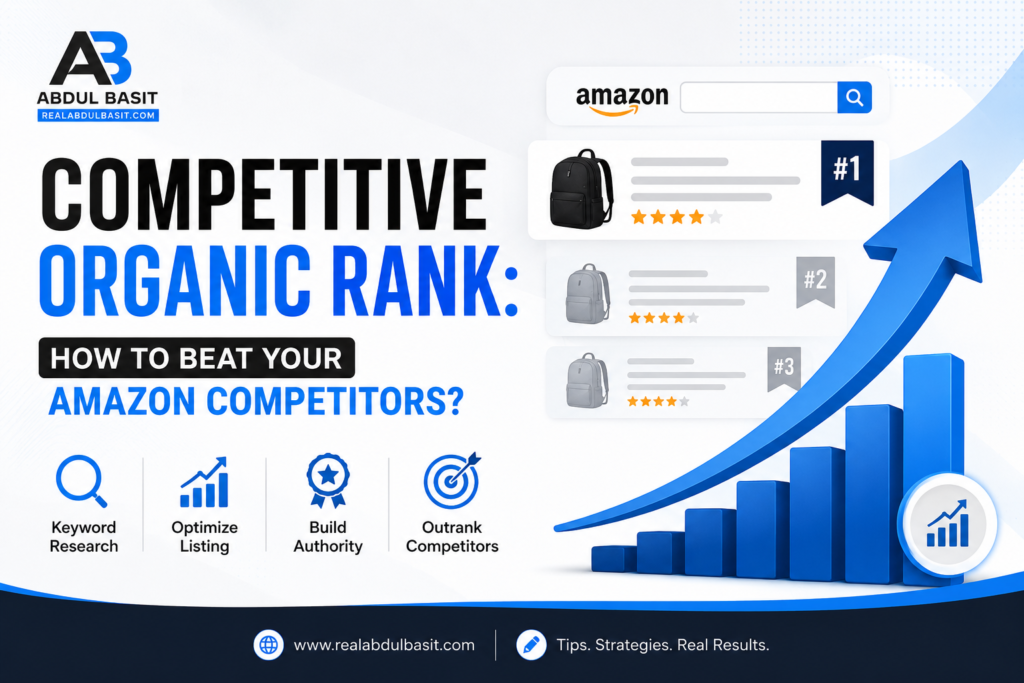
Competitive Organic Rank: How to Beat Your Amazon Competitors
Ranking on the first page of Amazon isn’t enough anymore.
If your competitors consistently appear above your products for important keywords, they’ll capture more clicks, more sales, and ultimately more market share.
This is where Competitive Organic Rank becomes one of the most important metrics for Amazon sellers.
Instead of looking only at your own keyword rankings, Competitive Organic Rank helps you understand how your product performs compared to other sellers competing for the same search terms.
In this guide, I’ll explain what Competitive Organic Rank is, why it matters, and how you can improve your rankings to outperform your competitors in 2026.
What Is Competitive Organic Rank?
Competitive Organic Rank refers to your product’s organic position in Amazon search results compared to competing products targeting the same keyword.
For example, if someone searches for “stainless steel water bottle” and your product appears in position #5 while your competitor ranks #2, your Competitive Organic Rank is lower than theirs.
The higher your ranking, the greater your chances of receiving organic traffic and sales without relying heavily on paid advertising.
Why Competitive Organic Rank Matters
Higher rankings lead to greater visibility.
Greater visibility often results in:
- More organic clicks
- Higher conversion rates
- Increased sales
- Lower advertising costs
- Better brand awareness
Many successful Amazon brands focus on improving Competitive Organic Rank because strong organic visibility reduces dependence on Amazon PPC over time.
How Amazon Determines Competitive Organic Rank
Amazon’s search algorithm evaluates multiple factors before deciding which products appear first.
Some of the most important ranking signals include:
- Keyword relevance
- Sales velocity
- Conversion rate
- Click-through rate (CTR)
- Customer reviews
- Product pricing
- Inventory availability
- Seller performance
- Customer satisfaction
Improving these factors helps increase your Competitive Organic Rank.
Optimize Product Listings for Competitive Organic Rank
Your listing is the foundation of Amazon SEO.
Optimize every important section:
Product Title
Include your primary keyword naturally.
Avoid keyword stuffing.
Bullet Points
Focus on customer benefits rather than simply listing product features.
Product Description
Write detailed, easy-to-read descriptions that answer customer questions.
Product Images
Use:
- High-resolution images
- Lifestyle photos
- Infographics
- Size comparison images
Professional visuals improve click-through and conversion rates.
Target High-Intent Keywords
Not every keyword deserves equal attention.
Focus on search terms that:
- Match customer intent
- Generate consistent traffic
- Have strong buying potential
- Relate directly to your product
Long-tail keywords often have lower competition and higher conversion rates.
Increase Your Click-Through Rate (CTR)
A higher CTR tells Amazon that shoppers find your listing relevant.
Improve CTR by optimizing:
- Main image
- Product title
- Price
- Promotions
- Star rating
Small improvements in CTR can significantly improve your Competitive Organic Rank over time.
Improve Your Conversion Rate
Getting clicks is only the first step.
Amazon rewards products that convert visitors into buyers.
Improve conversions by:
- Writing persuasive copy
- Adding A+ Content
- Using high-quality images
- Answering common customer questions
- Offering competitive pricing
The better your conversion rate, the stronger your organic ranking signals become.
Build More Customer Trust
Trust directly affects purchasing decisions.
Focus on:
- Excellent product quality
- Fast shipping
- Responsive customer support
- Honest product descriptions
Satisfied customers leave positive reviews and recommend your products.
Monitor Your Competitors
Successful Amazon sellers regularly analyze competing listings.
Pay attention to:
- Product titles
- Images
- Pricing
- Reviews
- Keywords
- A+ Content
- Product variations
Learning from competitors helps identify opportunities to improve your own listings.
Use Amazon PPC Strategically
Amazon PPC can support organic growth.
Launch campaigns to:
- Increase product visibility
- Generate sales velocity
- Discover profitable keywords
- Improve brand awareness
As organic rankings improve, your reliance on advertising should gradually decrease.
Build a Strong Amazon Brand
Strong brands outperform generic listings over time.
Invest in:
- Professional branding
- Consistent packaging
- Brand Store
- A+ Content
- Customer loyalty
Customers are more likely to choose brands they recognize and trust.
Common Mistakes That Hurt Competitive Organic Rank
Avoid these common mistakes:
❌ Keyword stuffing
❌ Poor-quality product images
❌ Weak product titles
❌ Ignoring customer reviews
❌ Running unoptimized PPC campaigns
❌ Frequent inventory stockouts
❌ Copying competitor listings
❌ Focusing only on paid advertising
Small mistakes can have a significant impact on your visibility.
Tools to Track Competitive Organic Rank
Several tools help monitor your rankings and competitor performance.
Popular options include:
- Helium 10
- Jungle Scout
- DataDive
- SellerApp
- Amazon Brand Analytics
These tools provide valuable insights into keyword rankings, search trends, and competitor performance.
Benefits of Improving Competitive Organic Rank
Higher organic rankings can help you:
- Increase free traffic
- Reduce advertising costs
- Improve profitability
- Generate consistent sales
- Strengthen brand authority
- Scale your Amazon business
Organic traffic is often more sustainable and profitable than relying solely on paid advertising.
Frequently Asked Questions
What is Competitive Organic Rank on Amazon?
Competitive Organic Rank measures how your product ranks organically against competing products for the same keyword in Amazon search results.
Why is Competitive Organic Rank important?
A higher Competitive Organic Rank increases product visibility, attracts more organic traffic, and reduces long-term dependence on Amazon PPC.
Can Amazon PPC improve Competitive Organic Rank?
PPC can increase visibility and sales velocity, which may indirectly improve organic rankings. However, long-term success depends on listing quality, customer experience, and conversion rates.
How often should I track my rankings?
Monitor important keywords weekly to identify ranking trends and respond to changes in competition.
Which tools help track Competitive Organic Rank?
Popular tools include Helium 10, Jungle Scout, DataDive, SellerApp, and Amazon Brand Analytics.
Related Articles
Continue Learning:
- How Amazon Organic Ranking Works in 2026
- Amazon Organic Ranking vs Sponsored Ranking Explained
- Why Your Amazon Product Is Not Ranking Organically
- The Amazon Ranking Secret Nobody Talks About
- How Amazon’s A10 Algorithm Works in 2026
- TACoS Explained: The Amazon PPC Metric Every Seller Should Track
- Amazon FBA AI Tools That Save Time and Increase Profit
External Resources
- Amazon Seller University
- Amazon Brand Registry
- Amazon Ads Learning Console
Need Help Improving Your Amazon Rankings?
Whether you’re launching a new product or trying to outrank established competitors, the right strategy can make a significant difference.
👉 Contact Me:
https://realabdulbasit.com/contact/
Final Verdict
Competitive Organic Rank is one of the clearest indicators of your product’s visibility and long-term success on Amazon.
Instead of relying only on paid advertising, focus on improving your listings, targeting the right keywords, increasing conversion rates, and delivering an outstanding customer experience.
Over time, these improvements will help you outperform competitors, generate more organic sales, and build a stronger, more profitable Amazon brand.