How Amazon Organic Ranking Works in 2026?
One of the most common questions Amazon sellers ask is:
“How do I rank my products organically on Amazon?”
It’s a great question because organic rankings are often the key to long-term success.
While Amazon PPC can drive immediate traffic, organic rankings generate consistent sales without requiring continuous advertising spend.
The higher your product ranks for relevant keywords, the more visibility, clicks, and sales it can receive.
However, many sellers still misunderstand how Amazon’s ranking algorithm actually works.
Some focus only on keywords.
Others believe reviews are everything.
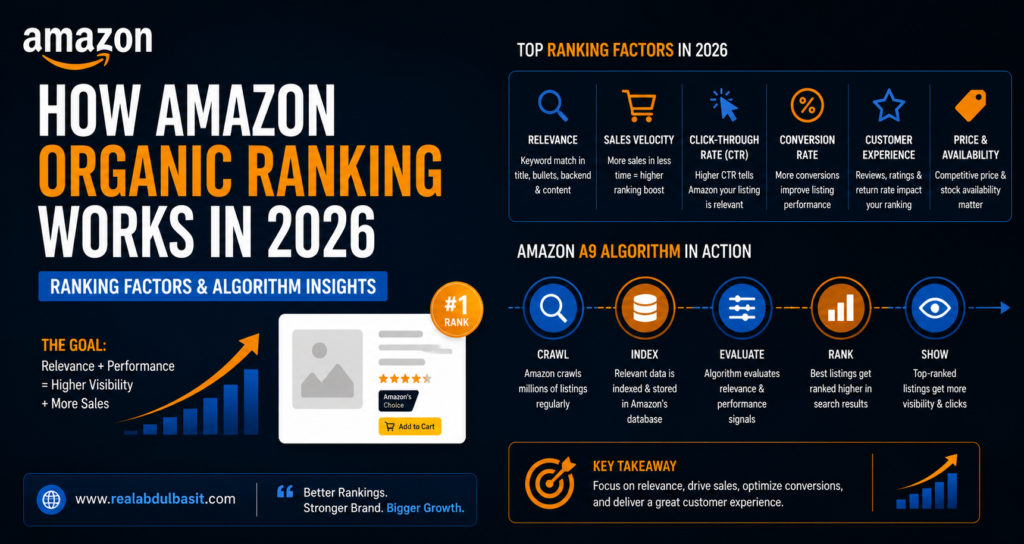
The truth is that Amazon’s algorithm evaluates multiple factors to determine which products deserve top positions.
In this guide, I’ll explain how Amazon organic ranking works in 2026, the ranking factors that matter most, and what sellers should focus on to improve visibility.
What Is Amazon Organic Ranking?
Amazon organic ranking refers to the position your product appears in search results without paid advertising.
For example:
If a customer searches:
“stainless steel water bottle”
and your product appears on page one without an ad label, that placement is an organic ranking.
Higher rankings generally lead to:
- More visibility
- More clicks
- More sales
- Better profitability
- Reduced PPC dependency
This is why organic rankings are so valuable.
Amazon’s Goal Is Simple
To understand rankings, you first need to understand Amazon’s primary objective.
Amazon wants to maximize:
Customer satisfaction and revenue.
The algorithm is designed to show products most likely to generate sales while providing a positive customer experience.
This means Amazon rewards products that consistently perform well.
The Two Major Ranking Components
Amazon’s search algorithm evaluates two primary areas:
Relevance
Can Amazon determine that your product matches the customer’s search query?
Performance
How well does your product perform when customers see it?
Both factors are essential.
A highly relevant product that doesn’t convert may struggle to rank.
Likewise, a great product without proper keyword optimization may never appear in search results.
Ranking Factor #1: Keyword Relevance
Keyword relevance remains one of the foundations of Amazon SEO.
Amazon needs to understand what your product is.
This information comes from:
- Product title
- Bullet points
- Product description
- Backend keywords
- A+ Content signals
- Brand information
The better Amazon understands your product, the more relevant searches it can appear for.
Where Keywords Matter Most
The most important locations include:
Product Title
Your title remains one of the strongest relevance signals.
Include important keywords naturally.
Avoid keyword stuffing.
Bullet Points
Bullet points help reinforce relevance while explaining benefits.
Focus on customer value first.
SEO second.
Backend Search Terms
Backend keywords help Amazon understand additional search variations without cluttering listings.
Use this space strategically.
Ranking Factor #2: Conversion Rate
Many sellers underestimate conversion rate.
However, it is one of Amazon’s strongest ranking signals.
Think about it logically.
If two products receive the same amount of traffic, Amazon prefers the product that generates more sales.
Higher conversion rates indicate stronger customer satisfaction.
What Improves Conversion Rates?
Several factors influence conversions:
- Product images
- Pricing
- Reviews
- Brand trust
- Product quality
- A+ Content
- Competitive positioning
Small improvements can significantly impact rankings.
Ranking Factor #3: Sales Velocity
Sales velocity refers to how quickly a product generates sales.
Products with strong sales momentum often rank higher.
Amazon interprets consistent sales as proof that customers want the product.
This is one reason PPC campaigns can help organic rankings.
More sales often create stronger ranking signals.
Why Product Launches Matter
New products typically lack sales history.
As a result, Amazon has limited data.
Generating early sales helps establish:
- Relevance
- Performance
- Customer demand
This is why launch strategies are so important.
Ranking Factor #4: Click-Through Rate (CTR)
Before a customer buys, they must click.
Amazon monitors how often shoppers click your listing after seeing it in search results.
A strong CTR suggests customers find your product appealing.
This often leads to better rankings over time.
What Improves CTR?
Key factors include:
- Main image quality
- Pricing
- Reviews
- Product title
- Brand recognition
Your search result appearance matters.
Ranking Factor #5: Customer Reviews
Reviews remain one of the most influential ranking factors.
They affect:
- Trust
- Conversion rates
- Click-through rates
More importantly, reviews influence customer decisions.
Products with strong review profiles often perform better overall.
Quality Matters More Than Quantity
Many sellers focus only on review counts.
However, review quality is equally important.
Consistent positive feedback helps strengthen customer confidence.
Ranking Factor #6: Product Availability
Amazon prefers products that remain consistently available.
Stockouts can harm rankings.
When inventory runs out:
- Sales stop
- Ranking momentum declines
- Organic visibility drops
Inventory management is often overlooked but extremely important.
Why Inventory Planning Matters
Running out of stock can undo months of ranking progress.
Maintain healthy inventory levels whenever possible.
Ranking Factor #7: Pricing Competitiveness
Price affects conversion rates.
Conversion rates affect rankings.
As a result, pricing indirectly influences organic visibility.
This doesn’t mean being the cheapest.
It means offering value that customers perceive as competitive.
Ranking Factor #8: PPC and Organic Rankings
Many sellers ask whether Amazon PPC affects organic rankings.
The answer is:
Indirectly, yes.
PPC generates:
- Visibility
- Traffic
- Sales
These sales create signals Amazon uses to evaluate products.
Therefore, well-managed PPC campaigns often support organic growth.
PPC Is a Ranking Accelerator
Think of PPC as a tool that helps generate data faster.
Advertising alone doesn’t guarantee rankings.
However, the sales generated from advertising often contribute to organic performance.
Ranking Factor #9: Customer Experience
Amazon prioritizes customer satisfaction.
Poor experiences can negatively affect performance.
Examples include:
- High return rates
- Negative reviews
- Product defects
- Customer complaints
Strong customer experience supports long-term rankings.
Ranking Factor #10: Brand Strength
In 2026, branding is becoming increasingly important.
Strong brands often benefit from:
- Better conversion rates
- More repeat customers
- Higher trust
- Improved click-through rates
Branding may not be a direct ranking factor, but it influences many signals Amazon values.
The Biggest Amazon SEO Myth
Many sellers believe Amazon SEO is only about keywords.
That isn’t true anymore.
Keywords help products appear.
Performance helps products stay ranked.
Both are required.
What Actually Drives Rankings Today
The strongest ranking strategy combines:
- Keyword relevance
- Conversion optimization
- PPC support
- Inventory management
- Customer satisfaction
- Strong branding
Amazon evaluates the entire customer journey.
Common Ranking Mistakes Sellers Make
Keyword Stuffing
Overloading listings with keywords often hurts readability and conversions.
Ignoring Conversion Rate
Traffic alone won’t improve rankings.
Sales matter.
Running Out of Stock
Inventory issues can damage ranking momentum.
Weak Product Images
Images directly affect click-through rates and conversions.
Depending Entirely on PPC
Advertising helps, but sustainable rankings require strong organic performance.
Related Articles
You may also find these guides helpful:
- How to Rank Your Amazon Product Organically Without Spending Too Much on PPC
- TACOS vs ACOS: Which Amazon PPC Metric Actually Matters?
- AI + Amazon FBA: The Growth Strategy I’m Using Right Now
- How to Build a Brand on Amazon Instead of Just Selling Products
You can also explore our Amazon SEO Optimization and Amazon Growth Consulting services.
External Resources
For official Amazon guidance, visit:
These resources provide additional insights into Amazon growth strategies.
Frequently Asked Questions
What is the most important Amazon ranking factor?
There isn’t a single ranking factor. Amazon evaluates keyword relevance, conversion rates, sales velocity, customer satisfaction, and other performance metrics together.
Does Amazon PPC improve organic rankings?
Indirectly, yes. PPC generates sales and visibility, which can contribute to stronger organic performance.
How long does it take to rank organically on Amazon?
The timeline varies based on competition, category, product quality, and marketing strategy. Some products rank within weeks, while others require several months.
Do reviews affect Amazon rankings?
Yes. Reviews influence conversion rates, trust, and customer behavior, all of which impact ranking performance.
Can I rank without PPC?
It’s possible, but significantly more difficult. PPC often accelerates the sales signals needed for ranking growth.
Final Verdict
Amazon organic ranking in 2026 is about much more than keywords.
The algorithm rewards products that consistently deliver strong customer experiences and generate sales.
To improve rankings, focus on:
- Keyword relevance
- Conversion optimization
- Sales velocity
- PPC support
- Inventory management
- Customer satisfaction
- Brand development
The sellers who understand these factors and optimize them consistently are the ones most likely to dominate organic search results.
In today’s Amazon marketplace, ranking is no longer just an SEO challenge.
It’s a business optimization challenge.