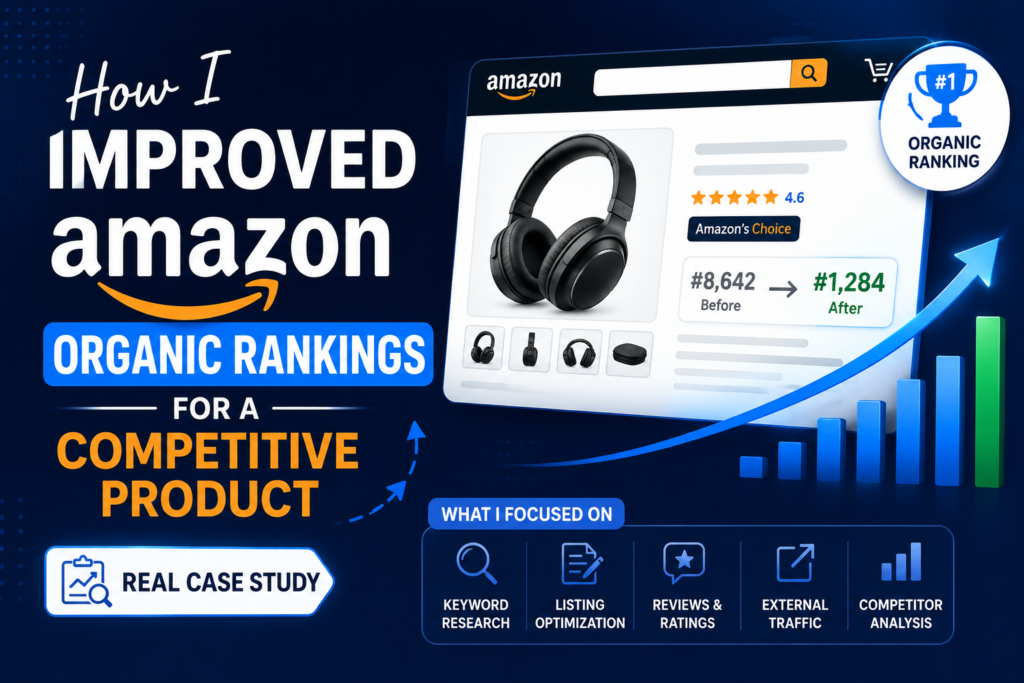
How I Improved Amazon Organic Rankings for a Competitive Product?
One of the biggest challenges on Amazon today is ranking a product in a highly competitive niche.
In low-competition categories, a well-optimized listing and a basic PPC strategy may be enough to generate results.
However, when you’re competing against established brands with thousands of reviews, large advertising budgets, and strong ranking history, the process becomes much more difficult.
Recently, I worked on a product in a competitive category where ranking improvements seemed almost impossible at first.
The niche was crowded.
Major competitors dominated the search results.
Advertising costs were rising.
Organic visibility was limited.
Despite these challenges, we gradually improved rankings, increased organic sales, and reduced dependence on paid advertising.
In this article, I’ll walk through the process, the strategies that worked, and the lessons learned along the way.
The Initial Situation
When I first analyzed the product, several issues became obvious.
The listing was receiving traffic through Amazon PPC campaigns, but organic rankings remained weak.
The product struggled to appear on the first page for important keywords.
As a result:
- Organic sales were limited
- Advertising costs were increasing
- TACOS remained higher than desired
- Growth was slowing
The goal was simple:
Increase organic rankings while maintaining profitability.
Step 1: Conducting a Complete Keyword Audit
The first thing I did was review keyword performance.
Many sellers target keywords based solely on search volume.
However, search volume alone doesn’t guarantee rankings or sales.
I analyzed:
- Existing ranking keywords
- Competitor keywords
- Long-tail opportunities
- Conversion-focused search terms
This process revealed several keywords that competitors were overlooking.
These became early ranking targets.
Why Long-Tail Keywords Matter
Trying to rank immediately for the biggest keyword in a niche is often unrealistic.
Instead, I focused on highly relevant long-tail keywords.
These keywords typically offer:
- Lower competition
- Higher buying intent
- Faster ranking opportunities
As rankings improved for smaller keywords, momentum began building for larger terms.
Step 2: Optimizing the Listing for Conversion
Traffic alone does not improve rankings.
Sales improve rankings.
That means conversion rate optimization is essential.
I reviewed every part of the listing, including:
Product Title
The title was updated to improve keyword relevance while remaining customer-friendly.
Bullet Points
Benefits were emphasized instead of simply listing features.
Product Description
The copy was rewritten to address customer concerns and buying motivations.
A+ Content
Enhanced content was added to improve trust and customer understanding.
The objective was simple:
Convert more visitors into buyers.
Step 3: Improving Product Images
One of the most impactful changes involved product images.
The original images were functional but not competitive.
We upgraded:
- Main image quality
- Lifestyle images
- Infographics
- Product demonstration visuals
The result was a noticeable improvement in click-through rate.
More clicks led to more opportunities for conversion.
Why Click-Through Rate Matters
Amazon wants products that shoppers engage with.
If customers consistently click your listing after seeing it in search results, Amazon receives a positive signal.
Improving CTR often supports stronger rankings over time.
Step 4: Restructuring PPC Campaigns
The PPC account was spending money, but not efficiently.
Instead of blindly increasing budgets, I reorganized campaigns.
The new structure focused on:
- Exact-match keywords
- High-converting search terms
- Search term isolation
- Better budget allocation
This improved advertising efficiency while supporting ranking efforts.
PPC as a Ranking Accelerator
Many sellers ask whether PPC improves organic rankings.
Directly, no.
Indirectly, yes.
PPC generates:
- Visibility
- Traffic
- Sales
Those sales create signals Amazon uses to evaluate product performance.
This makes PPC an important ranking tool.
Step 5: Eliminating Wasted Advertising Spend
A search term audit uncovered several expensive keywords that generated clicks but few conversions.
These terms were:
- Paused
- Bid down
- Added as negative keywords
This reduced waste and allowed more budget to flow toward profitable opportunities.
Step 6: Monitoring Organic Keyword Movement
One mistake many sellers make is focusing only on sales.
I closely monitored:
- Keyword rankings
- Organic visibility
- Search term performance
- Conversion trends
This helped identify which optimizations were having the greatest impact.
Data-driven decisions produced better results.
Step 7: Focusing on Customer Experience
Amazon rewards products that satisfy customers.
To strengthen customer experience, we focused on:
- Product quality
- Packaging
- Clear instructions
- Customer expectations
These improvements contributed to stronger reviews and better conversion rates.
The Role of Reviews
Reviews are not just social proof.
They influence:
- Trust
- Click-through rates
- Conversion rates
- Overall ranking performance
As review quality improved, organic growth accelerated.
Step 8: Maintaining Inventory Stability
Many sellers underestimate inventory management.
Running out of stock can destroy ranking momentum.
We maintained consistent inventory levels to avoid interruptions in sales performance.
This helped preserve ranking progress.
Results After Several Months
After implementing these changes, the product experienced significant improvements.
Key outcomes included:
| Metric | Before | After |
|---|---|---|
| Organic Rankings | Lower | Higher |
| Organic Sales | Limited | Increased |
| Conversion Rate | Improved | Improved |
| TACOS | Higher | Lower |
| PPC Efficiency | Improved | Improved |
The exact numbers vary by product and category.
However, the trend was clear.
Organic visibility increased substantially.
What Made the Biggest Difference?
Several factors contributed to success.
However, the most impactful improvements were:
- Better keyword targeting
- Conversion rate optimization
- PPC restructuring
- Image improvements
- Customer experience enhancements
No single tactic created the results.
Success came from combining multiple improvements.
Common Mistakes Sellers Make
Expecting Immediate Results
Organic rankings take time.
Amazon needs performance data before making major ranking adjustments.
Chasing Only High-Volume Keywords
Large keywords are attractive but often highly competitive.
Long-tail opportunities can produce faster wins.
Ignoring Conversion Rates
Traffic without conversions rarely improves rankings.
Over-Reliance on PPC
Advertising can help.
However, sustainable growth requires organic sales.
Neglecting Listing Quality
Even strong PPC campaigns struggle when listings fail to convert.
Lessons Learned
This case reinforced several important principles.
First, Amazon rankings are earned through performance.
Second, conversion rates matter as much as keyword optimization.
Third, PPC works best when supporting a broader growth strategy.
Most importantly, there are no shortcuts.
Long-term ranking improvements come from consistently improving the customer experience.
Related Articles
You may also find these guides helpful:
- How Amazon Organic Ranking Works in 2026
- Why Your Amazon Product Is Not Ranking Organically
- How to Rank Your Amazon Product Organically Without Spending Too Much on PPC
- Amazon Organic Ranking vs Sponsored Ranking Explained
You can also explore our Amazon SEO Optimization and Amazon PPC Management services for additional support.
External Resources
For additional learning, review:
- Amazon Seller University
- Amazon Advertising Learning Center
- Amazon Brand Registry
These official resources provide valuable insights into Amazon growth and optimization.
Frequently Asked Questions
How long does it take to improve Amazon organic rankings?
The timeline varies depending on competition, product quality, and strategy. Many sellers begin seeing movement within a few weeks, while major improvements often take several months.
Does Amazon PPC help organic rankings?
Indirectly, yes. PPC generates traffic and sales, which create performance signals that can contribute to organic growth.
What is the most important ranking factor?
There is no single ranking factor. Amazon evaluates relevance, conversion rates, sales velocity, customer satisfaction, and other performance signals together.
Can a new product rank in a competitive niche?
Yes, but it usually requires a strong listing, strategic PPC campaigns, excellent customer experience, and consistent optimization.
Why do some products lose rankings?
Common causes include declining conversion rates, increased competition, inventory shortages, poor customer feedback, and reduced sales velocity.
Final Verdict
Improving Amazon organic rankings in a competitive category is challenging, but it is absolutely possible.
The key is focusing on the factors Amazon values most:
- Relevance
- Conversion rates
- Sales velocity
- Customer satisfaction
- Listing quality
- Consistent performance
In this case, ranking improvements did not come from a single tactic.
They came from a complete optimization strategy that combined Amazon SEO, PPC management, conversion optimization, and customer-focused improvements.
If you’re struggling to rank in a competitive niche, focus on building a better product experience rather than looking for shortcuts.
That’s where sustainable organic growth begins.