
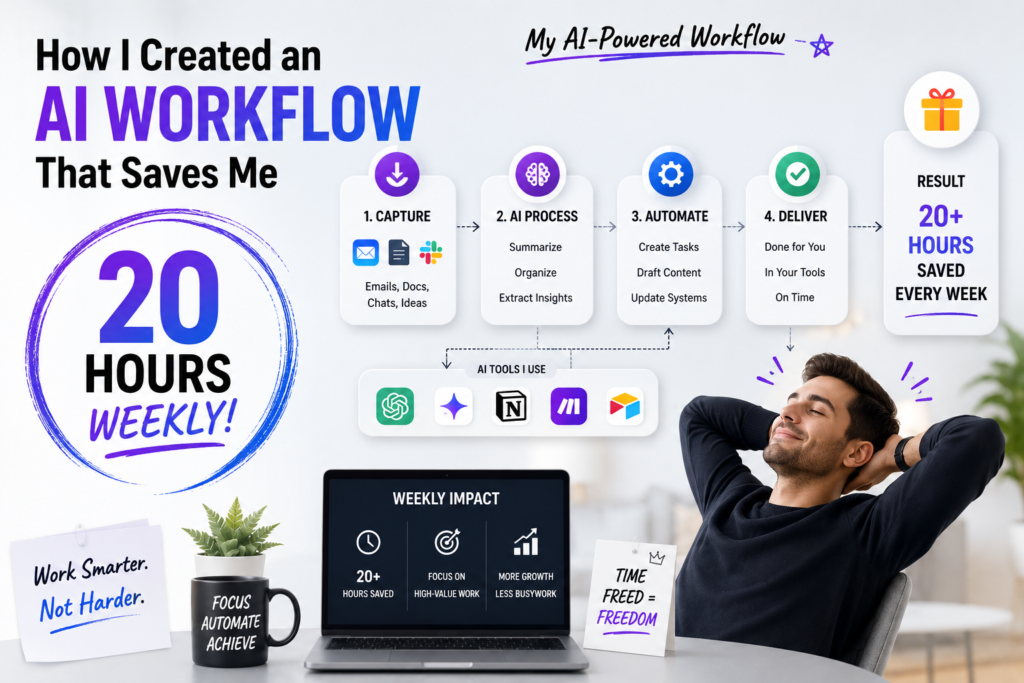
AI is no longer just a tool for writing content.
In 2026, it has become one of the biggest productivity advantages for online businesses.
A lot of people still use AI only for:
- basic prompts
- random content generation
- simple chatbot tasks
However, the real power of AI comes from building systems.
That is where the biggest time savings happen.
Over the last year, I started creating AI-assisted workflows for:
- research
- content creation
- marketing
- organization
- automation
- idea generation
- client work
And honestly, it completely changed how efficiently I work.
Today, these systems save me around 20 hours every week.
Not because AI replaced my thinking.
But because it removed repetitive work that used to consume huge amounts of time.
In this article, I’ll break down the AI workflow systems I use, how they improve productivity, and why automation is becoming essential for digital businesses in 2026.
Why Productivity Matters More Than Ever
Online business moves fast now.
There is constant pressure to:
- create content
- respond to trends
- manage clients
- optimize marketing
- analyze data
- stay visible
Without systems, workload becomes overwhelming quickly.
That is why productivity optimization matters so much.
The goal is not working harder.
The goal is reducing unnecessary friction.
What AI Helped Me Eliminate
Before using AI workflows seriously, I wasted a lot of time on:
- repetitive research
- organizing ideas
- rewriting content
- summarizing information
- brainstorming topics
- sorting data manually
None of these tasks directly generated revenue.
They simply consumed energy and time.
AI helped reduce those bottlenecks heavily.
AI Works Best as a Workflow Assistant
One important thing I learned is this:
AI is most powerful when connected to systems.
Using random prompts occasionally is helpful.
However, structured workflows create much bigger productivity gains.
That is where automation becomes valuable.
My Main AI Workflow Categories
The systems I use mostly focus on:
- content workflows
- marketing systems
- research automation
- productivity organization
- idea management
Each workflow saves small amounts of time individually.
Combined together, the savings become massive.
Workflow 1 — AI-Assisted Content Research
Research used to consume hours.
Especially when creating:
- blog posts
- marketing strategies
- Amazon content
- SEO articles
- educational material
Now AI helps organize research much faster.
What AI Helps Me Do During Research
AI speeds up:
- topic breakdowns
- content structuring
- trend analysis
- keyword organization
- summarizing information
- competitor analysis
This dramatically reduces preparation time.
Why Research Speed Matters
Faster research allows more time for:
- strategy
- creativity
- editing
- branding
- audience understanding
Those areas create better long-term results.

Workflow 2 — Content Repurposing Automation
This is one of my biggest productivity advantages.
Instead of creating every piece of content from scratch, I repurpose ideas into multiple formats.
For example:
- one blog becomes social posts
- one topic becomes short-form content
- one idea becomes email content
AI helps accelerate this process heavily.
Why Repurposing Is So Powerful
Most people underuse their best ideas.
Repurposing increases:
- content output
- consistency
- visibility
- efficiency
without multiplying workload.
That creates better long-term growth.
Workflow 3 — AI for SEO Optimization
SEO work can become repetitive quickly.
AI helps simplify:
- keyword organization
- title ideas
- content structures
- optimization suggestions
- search intent analysis
This speeds up blog production significantly.
SEO Still Requires Human Strategy
AI helps with optimization.
However, ranking content still depends heavily on:
- quality
- usefulness
- audience understanding
- search intent
Human judgment still matters heavily.
Workflow 4 — AI for Marketing Systems
Marketing includes many repetitive tasks.
AI now helps streamline:
- campaign ideas
- ad copy variations
- email drafts
- audience segmentation
- funnel planning
This reduces creative fatigue significantly.
Why Marketing Automation Matters
Without systems, marketing becomes exhausting.
Automation helps maintain:
- consistency
- speed
- organization
while freeing more mental energy for strategic thinking.
Workflow 5 — AI Note Organization
One underrated productivity problem is information overload.
Ideas constantly appear during:
- meetings
- research
- browsing
- conversations
AI helps organize and summarize notes faster.
This prevents losing valuable information.
Why Organization Improves Productivity
Mental clutter reduces focus.
Clear systems improve:
- decision-making
- execution speed
- consistency
- planning
Organization is an underrated business advantage.
Workflow 6 — AI for Client Work Efficiency
AI also improves service delivery.
For client projects, automation helps with:
- research summaries
- campaign preparation
- draft generation
- reporting structures
- workflow organization
This allows faster execution without sacrificing quality.
The Biggest Mistake People Make With AI
Many people expect AI to fully replace work.
That mindset usually creates:
- generic content
- weak branding
- low-quality execution
AI should improve workflows.
Not eliminate human thinking.
AI Is Best at Removing Repetition
The biggest productivity gains usually come from automating:
- repetitive tasks
- low-value admin work
- formatting
- organization
- summarization
That creates more time for:
- creativity
- strategy
- decision-making
which humans still perform better.
Why Human Creativity Still Matters
The internet is already flooded with:
- generic AI content
- repetitive writing
- copied ideas
That is why:
- personality
- originality
- perspective
- experience
matter even more now.
AI improves speed.
Humans create differentiation.
My Biggest Productivity Lesson
The goal is not using more AI tools.
The goal is building better systems.
A few strong workflows are usually more valuable than dozens of disconnected automation tools.
Simple systems often scale best.

How AI Reduced Burnout
One unexpected benefit was reduced mental exhaustion.
Before automation systems, repetitive work consumed huge amounts of focus.
Now AI handles many smaller operational tasks.
That creates more energy for meaningful work.
Common AI Productivity Mistakes
1. Using Too Many Tools
Too many disconnected tools create confusion.
2. Automating Bad Systems
Automation improves systems.
If the workflow is weak, automation scales inefficiency.
3. Depending Entirely on AI
Human thinking still matters heavily.
4. Ignoring Organization
Without structure, automation becomes messy.
5. Chasing Hype Instead of Efficiency
Not every AI tool creates real productivity gains.
What Actually Works in 2026
The people benefiting most from AI usually focus on:
- workflow optimization
- organization
- automation systems
- content repurposing
- productivity efficiency
instead of blindly automating everything.
That balance matters.
Helpful Resources for AI Productivity
You can explore more productivity and automation strategies through:
Learning how to combine AI with strong systems creates the biggest advantage.
Final Thoughts
AI has completely changed how I manage productivity and workflows.
The biggest improvement was not replacing work entirely.
It was removing repetitive friction.
By combining:
- AI tools
- automation systems
- structured workflows
- productivity optimization
I was able to save around 20 hours every week while improving consistency and output quality.
And honestly, I believe businesses that learn how to combine:
- human creativity
- strategic thinking
- AI-assisted efficiency
will have one of the biggest advantages online in the coming years.