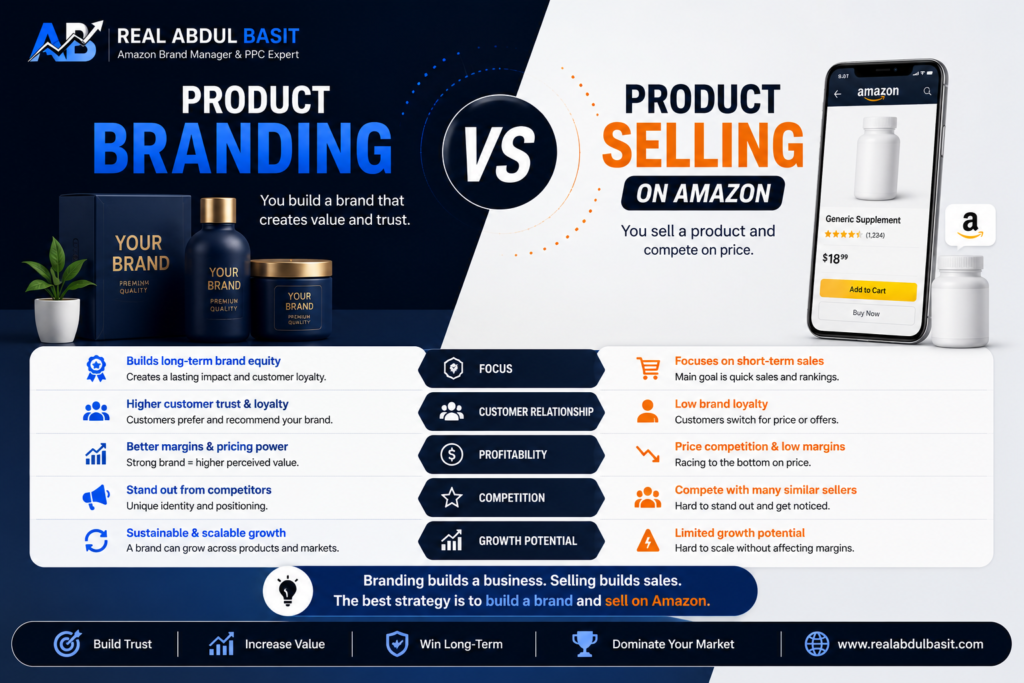
Product Branding vs Product Selling on Amazon: Which Strategy Wins in 2026?
Many Amazon sellers start by focusing on one goal: selling products quickly. They find a product, launch it, run PPC campaigns, and hope to generate sales.
While this approach can work initially, it often leads to intense competition, shrinking margins, and limited growth.
The sellers building long-term success on Amazon are doing something different. They are building brands, not just selling products.
In this guide, I’ll explain the difference between product selling and product branding, why branding matters more than ever in 2026, and how Amazon sellers can create sustainable businesses instead of chasing short-term sales.
What Is Product Selling on Amazon?
Product selling focuses primarily on generating sales for individual products.
Typical characteristics include:
- Competing mainly on price
- Generic product listings
- Minimal brand identity
- Heavy reliance on PPC advertising
- Little customer loyalty
- Frequent product switching
The goal is simple:
Find products that sell and maximize short-term revenue.
Many new Amazon sellers start with this model because it appears easier and requires less brand development.
What Is Product Branding on Amazon?
Product branding is the process of creating a recognizable business that customers remember and trust.
A branded Amazon business focuses on:
- Unique brand identity
- Consistent messaging
- Customer experience
- Product differentiation
- Repeat purchases
- Long-term growth
Instead of selling a random product, you create a business customers actively search for.
Examples include well-known Amazon-native brands that started small but eventually became industry leaders.
Product Branding vs Product Selling: Key Differences
| Factor | Product Selling | Product Branding |
|---|---|---|
| Focus | Individual Products | Long-Term Business |
| Customer Loyalty | Low | High |
| Repeat Purchases | Limited | Strong |
| Price Competition | High | Lower |
| Brand Recognition | Minimal | Significant |
| Business Value | Lower | Higher |
| Profit Stability | Unpredictable | More Stable |
| Long-Term Growth | Limited | Scalable |
Why Product Selling Is Becoming Harder in 2026
Amazon continues to become more competitive every year.
Challenges include:
- Rising PPC costs
- More sellers entering the marketplace
- AI-generated listings increasing competition
- Higher customer expectations
- Price wars in crowded niches
Sellers relying only on product selling often struggle to maintain profitability.
Without a recognizable brand, competitors can easily copy products and undercut pricing.
Why Branding Matters More Than Ever
Strong brands create advantages that generic sellers cannot easily replicate.
Benefits include:
Higher Customer Trust
Customers prefer buying from brands they recognize.
Trust increases:
- Conversion rates
- Average order value
- Repeat purchases
Better Organic Rankings
Amazon rewards products that generate:
- Consistent sales
- Strong click-through rates
- Positive reviews
- Customer engagement
Brand recognition often improves these metrics naturally.
Learn more about Amazon rankings in our guide:
Internal Link: How Amazon Organic Ranking Works in 2026
Reduced Dependence on PPC
Many sellers rely entirely on advertising.
Brands often receive:
- Branded searches
- Direct traffic
- Repeat customers
- Referral traffic
This lowers advertising dependence and helps reduce TACOS over time.
Internal Link: What Is TACOS in Amazon Advertising?
Increased Business Value
Businesses with strong brands are generally worth more than businesses selling generic products.
Investors often value:
- Brand recognition
- Customer loyalty
- Market positioning
Much higher than a collection of individual listings.
Real Seller Scenario
Seller A: Product Seller
- Launches a kitchen product
- Competes on price
- Runs aggressive PPC
- Generates sales quickly
After six months:
- Competition increases
- Margins shrink
- TACOS rises
- Profit declines
Seller B: Brand Builder
- Launches the same product
- Creates brand identity
- Builds premium packaging
- Focuses on customer experience
After six months:
- Stronger reviews
- More branded searches
- Better conversion rates
- Lower long-term advertising costs
The second seller often creates a more sustainable business.
How to Build a Brand on Amazon
1. Define Your Brand Identity
Ask yourself:
- What does your brand stand for?
- Who is your target customer?
- Why should customers choose you?
Clear positioning creates differentiation.
2. Create Professional Branding
Focus on:
- Logo design
- Packaging
- Product photography
- Storefront design
Consistency improves recognition.
3. Register Your Brand
Enroll in Amazon Brand Registry.
Benefits include:
- Brand protection
- A+ Content
- Sponsored Brands Ads
- Enhanced analytics
4. Build a Brand Store
Amazon Stores allow customers to explore your product ecosystem.
Benefits include:
- Higher engagement
- Better cross-selling
- Stronger brand perception
5. Focus on Customer Experience
Brand growth comes from satisfied customers.
Improve:
- Product quality
- Packaging
- Instructions
- Support
Positive experiences drive repeat purchases.
6. Expand Strategically
Instead of launching random products, expand within your niche.
Example:
A fitness brand may add:
- Resistance bands
- Workout accessories
- Recovery tools
This strengthens brand authority.
Common Branding Mistakes
Many Amazon sellers make these mistakes:
❌ Copying competitors
❌ Ignoring customer experience
❌ Poor packaging
❌ No brand story
❌ Weak product images
❌ Overreliance on PPC
❌ Chasing trends without strategy
Avoiding these mistakes helps create stronger market positioning.
Benefits of Building a Brand
- Higher customer trust
- Better organic rankings
- Improved conversion rates
- More repeat purchases
- Lower long-term TACOS
- Greater business valuation
- Sustainable growth
Frequently Asked Questions
Is branding important for Amazon FBA?
Yes. Branding helps sellers stand out, build customer loyalty, and reduce dependence on advertising.
Can a small seller build a brand?
Absolutely. Many successful Amazon brands started with a single product.
Does branding improve Amazon rankings?
Indirectly, yes. Strong brands often generate better engagement, conversions, and repeat purchases, which support ranking improvements.
What is Amazon Brand Registry?
Amazon Brand Registry is a program that provides tools to protect intellectual property and improve brand visibility.
Should I focus on branding or selling?
Selling generates revenue, but branding creates long-term business value. The best strategy combines both.
Related Articles
Continue learning:
- How to Build a Brand on Amazon Instead of Just Selling Products
- Amazon Organic Ranking vs Sponsored Ranking Explained
- The Real Difference Between ACOS, TACOS, and ROAS
- Why Your Amazon Product Is Not Ranking Organically
- Amazon FBA AI Tools Every Seller Should Know
Need help building and scaling an Amazon brand?
👉 Contact Me:
https://realabdulbasit.com/contact/
External Resources
- Amazon Brand Registry
- Amazon Seller University
- Amazon Advertising Learning Console
Final Verdict
In 2026, simply selling products on Amazon is no longer enough for sustainable growth.
Product sellers often face increasing competition, rising advertising costs, and shrinking margins.
Brand builders create something much more valuable:
- Customer trust
- Repeat purchases
- Stronger rankings
- Better profitability
- Long-term business growth
If your goal is to build a real business instead of chasing short-term sales, focus on creating a brand that customers remember, trust, and choose repeatedly.
That’s where the biggest opportunities on Amazon exist today.