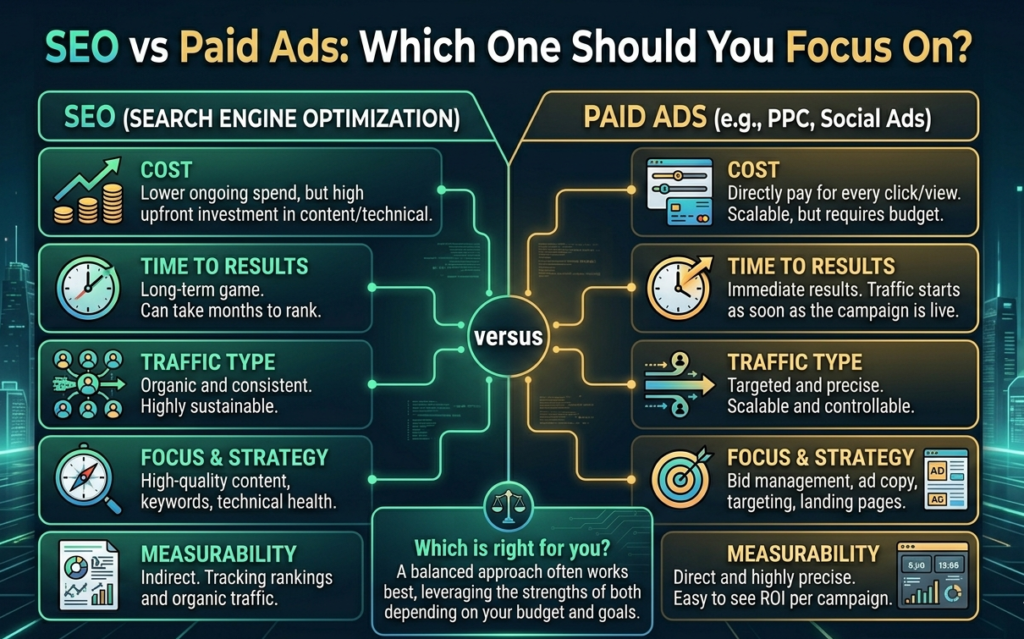
One of the biggest questions businesses ask in digital marketing is:
“Should I focus on SEO or paid ads?”
And honestly, there’s no universal answer.
Both strategies can grow a business.
But they work very differently.
SEO is usually a long-term traffic asset.
Paid ads are usually a short-term growth accelerator.
The mistake most businesses make is treating them like direct competitors instead of understanding when and how each one works best.
In 2026, smart businesses usually combine both strategically.
But if your budget, time, or resources are limited, knowing where to focus first becomes extremely important.
In this article, I’ll break down:
- how SEO and paid ads actually work
- the pros and cons of each
- which strategy fits different business stages
- and how I personally think about long-term online growth
What SEO Actually Does
SEO (Search Engine Optimization) helps your content rank organically on search engines like Google.
Instead of paying for every click, you create:
- blog posts
- landing pages
- guides
- optimized content
that attract traffic over time.
Good SEO content can continue bringing visitors for months or even years.
That’s why SEO is often considered a long-term digital asset.
Why SEO Is Powerful
SEO traffic usually has:
- strong intent
- high trust
- long-term consistency
- compounding growth potential
When someone searches:
- “best Amazon PPC strategy”
or - “how to start AI freelancing”
they’re actively looking for information or solutions.
That intent matters.
The Biggest Advantage of SEO
The biggest strength of SEO is sustainability.
Unlike ads, traffic doesn’t instantly disappear when you stop spending money.
Good SEO compounds over time.
Every:
- article
- ranking page
- optimized keyword
- internal link
becomes part of your long-term traffic system.
The Problem With SEO
SEO is slower.
That’s the reality many people dislike.
You usually won’t publish an article today and rank tomorrow.
SEO often requires:
- patience
- consistency
- quality content
- authority building
- optimization
Results may take:
- months
- sometimes longer
depending on competition.
That frustrates businesses wanting immediate growth.
What Paid Ads Actually Do
Paid advertising gives you immediate visibility.
You can run ads on:
- TikTok
- YouTube
- Amazon
and start generating traffic almost instantly.
That speed is powerful.
Why Businesses Love Paid Ads
Ads provide:
- fast traffic
- quick testing
- scalable reach
- targeting control
- measurable data
If your campaigns work well, ads can scale growth very quickly.
That’s why many businesses rely heavily on them.
The Biggest Advantage of Paid Ads
Speed.
You can:
- test offers quickly
- validate products faster
- generate leads immediately
- accelerate visibility
Paid ads are excellent for businesses needing momentum fast.
The Problem With Paid Ads
The moment you stop spending money, traffic usually stops too.
That creates dependency.
And in 2026, ad costs are increasing constantly because competition keeps growing.
Without:
- strong branding
- optimized funnels
- good conversion rates
ads become expensive quickly.
SEO vs Paid Ads — The Core Difference
The simplest way to think about it is this:
SEO Builds Assets
Content compounds long term.
Paid Ads Rent Attention
Traffic lasts while spending continues.
Both can work.
But they serve different purposes.
When SEO Makes More Sense
SEO is usually better when:
- you want long-term traffic
- your budget is limited
- you enjoy content creation
- authority matters in your niche
- you want sustainable growth
- your business relies on education or trust
SEO works especially well for:
- blogs
- personal brands
- affiliate websites
- service businesses
- educational businesses
- SaaS companies
Why SEO Is Powerful for Personal Brands
People searching organically often:
- trust content more
- spend more time reading
- build stronger relationships
SEO also helps establish expertise naturally.
That’s extremely valuable long term.
When Paid Ads Make More Sense
Paid ads usually work better when:
- you need immediate traffic
- you already have validated offers
- your funnels convert well
- you have advertising budget
- speed matters heavily
Ads are especially useful for:
- eCommerce
- lead generation
- product launches
- local businesses
- fast scaling
The Biggest Mistake Businesses Make
Many businesses jump into ads before fixing:
- branding
- conversion rates
- messaging
- funnels
- customer understanding
That leads to wasted budgets.
Ads amplify existing systems.
If the system is weak, ads usually expose weaknesses faster.
Why SEO and Ads Work Better Together
This is something many people misunderstand.
SEO and paid ads are not enemies.
They can strengthen each other.
Example
SEO can:
- build authority
- generate organic traffic
- establish trust
- reduce long-term acquisition costs
Paid ads can:
- accelerate testing
- increase visibility
- scale successful systems faster
Combined properly, they create a much stronger marketing ecosystem.
My Personal View on Long-Term Growth
If I had to choose only one strategy long term, I’d personally lean toward SEO and content systems.
Why?
Because:
- traffic compounds
- authority grows
- trust increases
- content becomes an asset
- customer acquisition costs decrease over time
But that does not mean ads are bad.
Ads are extremely powerful when used strategically.
The Smartest Approach for Most Businesses
In my opinion, the strongest growth strategy usually looks like this:
Phase 1 — Build Foundations
- branding
- positioning
- content systems
- SEO structure
Phase 2 — Validate Messaging
- audience understanding
- conversion optimization
- content performance
Phase 3 — Scale With Ads
Once systems work organically, ads can amplify growth faster.
That approach is usually more sustainable.
SEO Creates Compounding Growth
One important thing many businesses underestimate is compounding.
Every quality article:
- increases authority
- improves discoverability
- builds topical relevance
- attracts future traffic
Over time, this creates momentum.
That’s why older websites often become much stronger traffic assets.
Paid Ads Create Controlled Growth
Ads offer something SEO cannot:
control.
You can:
- target specific audiences
- adjust campaigns quickly
- scale aggressively
- test offers rapidly
That flexibility is extremely valuable.
Especially for businesses prioritizing speed.
Common Mistakes Businesses Make
1. Expecting SEO Results Too Fast
SEO requires patience.
Most people quit too early.
2. Running Ads Without Strategy
Ads without:
- positioning
- strong offers
- optimized funnels
usually waste money.
3. Ignoring Content Completely
Content builds trust.
Without trust, customer acquisition becomes harder.
4. Depending Only on One Traffic Source
Relying entirely on either SEO or ads creates vulnerability.
Diversification matters.
What Actually Works in 2026
The businesses growing strongest today usually combine:
- SEO
- content marketing
- branding
- email systems
- strategic advertising
instead of relying on only one tactic.
Everything supports everything else.
Final Thoughts
SEO and paid ads are not really competitors.
They are tools designed for different goals.
SEO is better for:
- long-term authority
- sustainable traffic
- compounding growth
Paid ads are better for:
- speed
- testing
- immediate visibility
- fast scaling
The smartest businesses understand how to use both strategically instead of arguing which one is “better.”
Because in 2026, sustainable online growth usually comes from combining:
- traffic systems
- trust
- branding
- content
- conversion strategy
into one connected marketing ecosystem.