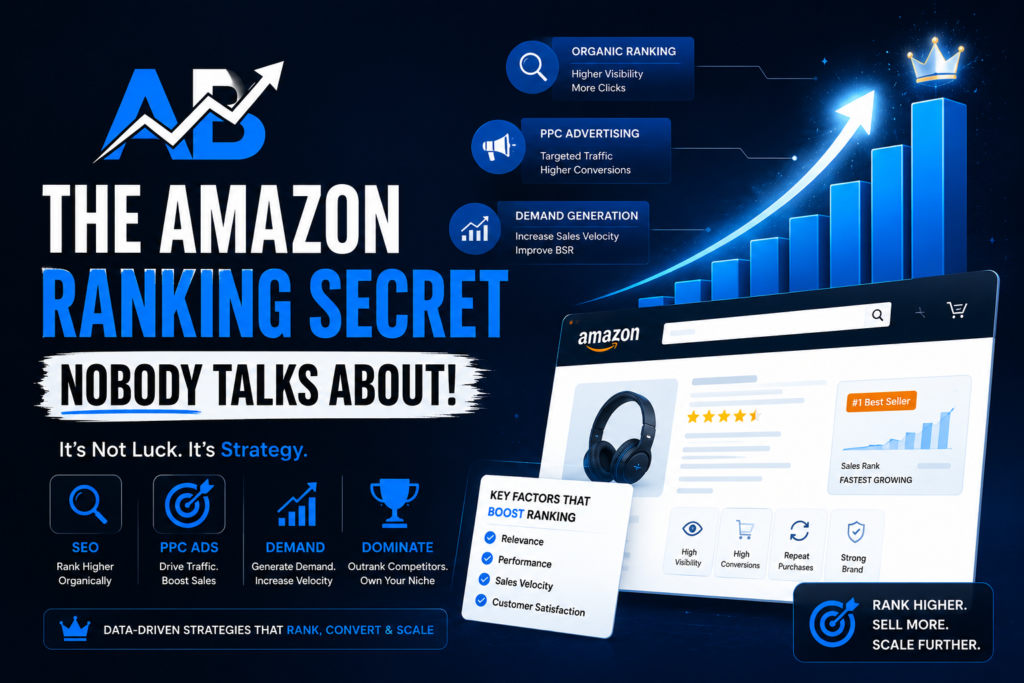
The Amazon Ranking Secret Nobody Talks About
Every Amazon seller wants the same thing:
Higher rankings.
More visibility.
More sales.
As a result, sellers spend countless hours researching keywords, optimizing listings, and adjusting PPC campaigns.
While these activities are important, there’s one ranking factor that many sellers underestimate.
In fact, it’s the reason why some products with fewer reviews and smaller budgets outperform larger competitors.
The Amazon ranking secret nobody talks about is this:
Amazon rewards products that consistently convert shoppers into buyers.
Not the products with the most keywords.
Not necessarily the products with the biggest advertising budgets.
And not always the products with the most reviews.
At its core, Amazon’s algorithm is designed to maximize sales and customer satisfaction.
Understanding this principle changes everything.
What Most Sellers Think About Amazon SEO
When sellers talk about ranking, the conversation usually focuses on:
- Keywords
- Backend search terms
- PPC campaigns
- Search volume
- Competitor analysis
These factors matter.
However, they only solve part of the ranking equation.
Keywords help Amazon understand your product.
They do not guarantee rankings.
What Amazon Actually Wants
Amazon’s business model is simple.
The platform makes money when customers buy products.
Therefore, Amazon wants to display products that are most likely to generate sales.
Think about it from Amazon’s perspective.
If two products target the same keyword:
- Product A converts 5% of visitors
- Product B converts 15% of visitors
Which product creates more revenue for Amazon?
The answer is obvious.
Over time, Amazon is more likely to reward Product B.
This is where many sellers miss the bigger picture.
The Real Ranking Formula
Most ranking discussions focus heavily on relevance.
Relevance is important because Amazon must understand what your product is.
However, relevance alone isn’t enough.
A simplified version of Amazon’s ranking logic looks something like this:
Relevance + Performance = Organic Rankings
Performance includes:
- Conversion rate
- Sales velocity
- Click-through rate
- Customer satisfaction
- Review quality
These factors often determine whether a product climbs or disappears.
Why Conversion Rate Is So Powerful
Conversion rate measures the percentage of visitors who purchase your product.
For example:
If 100 people visit your listing and 15 buy the product, your conversion rate is 15%.
Higher conversion rates send a strong signal to Amazon.
The algorithm interprets this as:
“Customers like this product.”
As a result, rankings often improve.
The Hidden Connection Between PPC and Organic Rankings
Many sellers ask:
“Does Amazon PPC improve organic rankings?”
The answer is indirect.
PPC itself isn’t the ranking factor.
The sales generated through PPC are.
When advertising drives qualified traffic and conversions, Amazon receives more performance data.
If those shoppers buy, rankings often improve.
This is why some products gain organic visibility after running effective PPC campaigns.
Why Some Products Never Rank
I’ve audited dozens of Amazon accounts over the years.
One pattern appears repeatedly.
Many sellers focus entirely on traffic and ignore conversions.
They think:
“If I can get more clicks, I’ll rank higher.”
Unfortunately, traffic without sales rarely works.
Amazon doesn’t reward visits.
Amazon rewards purchases.
The Conversion Optimization Strategy
Instead of asking:
“How do I get more traffic?”
Ask:
“How do I convert more of the traffic I already have?”
This shift in thinking can transform a business.
Areas That Influence Conversion Rate
Product Images
Images are often the first thing shoppers notice.
Strong images can dramatically improve click-through rates and conversions.
Focus on:
- High-resolution visuals
- Lifestyle images
- Infographics
- Product demonstrations
Product Title
A title should communicate value while maintaining keyword relevance.
Avoid keyword stuffing.
Write for customers first.
Bullet Points
Many listings simply list product features.
Top-performing listings explain benefits.
Customers care about outcomes, not specifications.
A+ Content
A+ Content helps educate buyers and build trust.
When used correctly, it can increase conversion rates significantly.
Pricing Strategy
Price affects customer perception.
Being the cheapest isn’t always the best strategy.
Instead, focus on providing clear value.
Customer Experience Is the Real Ranking Advantage
Another ranking factor that receives little attention is customer experience.
Amazon closely monitors signals such as:
- Reviews
- Returns
- Refunds
- Customer complaints
Products that consistently satisfy customers often perform better over time.
This is one reason why ranking improvements are difficult to fake.
Eventually, customer behavior reveals the truth.
Why Reviews Matter Beyond Social Proof
Most sellers view reviews as trust signals.
While that’s true, reviews also influence conversion rates.
Higher ratings generally lead to:
- More clicks
- More purchases
- Better rankings
This creates a positive feedback loop.
Better reviews lead to stronger performance.
Stronger performance leads to better rankings.
The Sales Velocity Effect
Sales velocity refers to how quickly a product generates sales.
Products experiencing consistent sales momentum often receive ranking boosts.
Amazon interprets strong sales activity as proof of demand.
This is why successful product launches often prioritize generating early sales.
The Biggest Ranking Mistake Sellers Make
The most common mistake is focusing on ranking instead of focusing on customers.
Many sellers ask:
“How can I rank for this keyword?”
A better question is:
“How can I create a better buying experience than competitors?”
The second question naturally improves rankings.
What Successful Amazon Brands Do Differently
The highest-performing brands focus on:
- Product quality
- Customer satisfaction
- Listing optimization
- Conversion rates
- Long-term trust
They understand that rankings are a result of performance.
Not the other way around.
A Real Example
Imagine two sellers targeting the same keyword.
Seller A
- Excellent keyword optimization
- Weak images
- Average reviews
- Low conversion rate
Seller B
- Good keyword optimization
- Excellent images
- Strong reviews
- High conversion rate
Over time, Seller B will often outrank Seller A.
Even if Seller A has slightly better keyword placement.
Why?
Because Amazon values performance.
How to Improve Rankings Faster
If you want better rankings, focus on these priorities:
First
Improve conversion rates.
Second
Increase sales velocity.
Third
Optimize customer experience.
Fourth
Refine keyword targeting.
Most sellers reverse this order.
That’s why many struggle.
Related Articles
You may also find these guides helpful:
- How Amazon Organic Ranking Works in 2026
- Why Your Amazon Product Is Not Ranking Organically
- How to Rank Your Amazon Product Organically Without Spending Too Much on PPC
- Amazon Organic Ranking vs Sponsored Ranking Explained
You can also explore our Amazon SEO Optimization and Amazon PPC Management services for personalized support.
External Resources
For additional learning, review:
These official Amazon resources provide valuable insights into ranking and growth strategies.
Frequently Asked Questions
What is the biggest Amazon ranking factor?
There is no single ranking factor, but conversion rate is one of the strongest indicators Amazon uses when evaluating product performance.
Do keywords still matter on Amazon?
Yes. Keywords help Amazon understand product relevance. However, rankings also depend heavily on performance metrics.
Does PPC improve rankings?
Indirectly. PPC generates traffic and sales, which can contribute to stronger ranking signals.
Why do some products with fewer reviews rank higher?
Products with strong conversion rates, customer satisfaction, and sales velocity can outperform competitors with more reviews.
What should I focus on first to improve rankings?
Start by improving conversion rates, product images, listing quality, and customer experience before obsessing over keyword placement.
Final Verdict
The Amazon ranking secret nobody talks about isn’t hidden inside a keyword tool or a PPC dashboard.
It’s much simpler.
Amazon rewards products that help customers make purchasing decisions and deliver positive experiences after the sale.
Keywords help products get discovered.
Conversions help products get ranked.
Customer satisfaction helps products stay ranked.
The sellers who understand this principle stop chasing shortcuts and start building listings, products, and brands that customers genuinely prefer.
And that’s where sustainable Amazon growth begins.