What Is TACOS in Amazon Advertising?
If you’re running Amazon PPC campaigns, you’ve probably heard experienced sellers talk about TACOS.
Many beginners focus only on ACOS when evaluating advertising performance. While ACOS is important, it doesn’t tell the complete story.
That’s where TACOS comes in.
TACOS helps sellers understand whether their advertising efforts are contributing to overall business growth rather than just generating ad sales.
In this guide, you’ll learn:
- What TACOS means
- How to calculate TACOS
- TACOS vs ACOS
- Why TACOS matters
- How to improve TACOS
- Common mistakes Amazon sellers make
By the end of this article, you’ll understand why many successful Amazon brands consider TACOS one of the most important PPC metrics.
What Does TACOS Stand For?
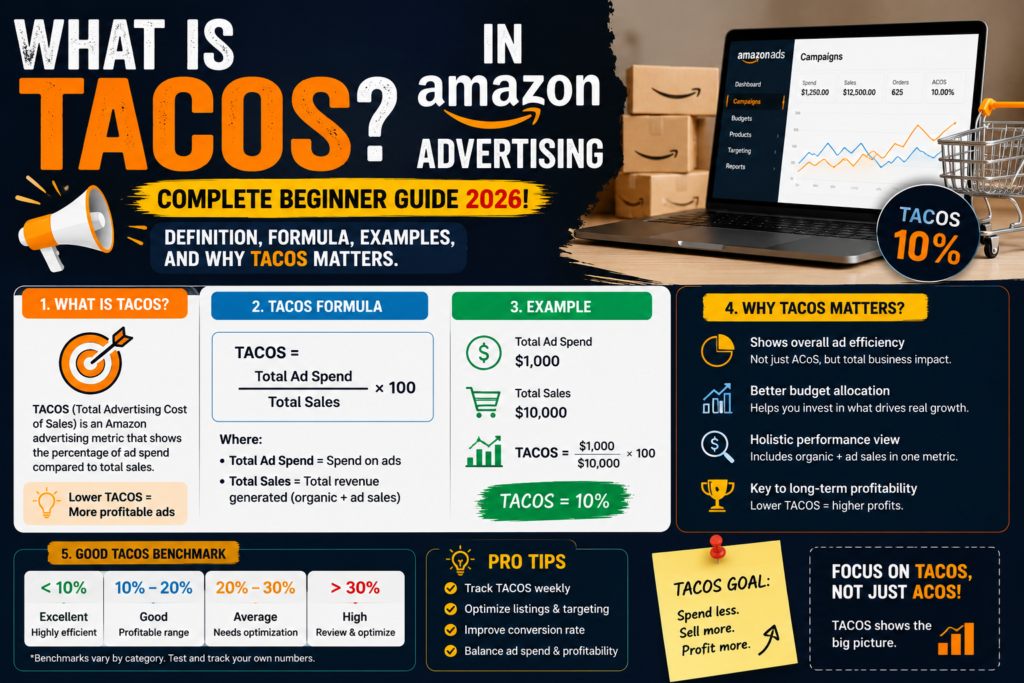
TACOS stands for:
Total Advertising Cost of Sales
It measures the percentage of your total revenue spent on advertising.
Unlike ACOS, which only looks at sales generated from ads, TACOS includes all sales, including organic sales.
This gives you a broader picture of your business performance.
TACOS Formula
The formula is simple:
TACOS = Advertising Spend ÷ Total Revenue × 100
Example
Let’s assume:
- Ad Spend = $1,000
- Total Revenue = $10,000
Calculation:
$1,000 ÷ $10,000 × 100 = 10%
Your TACOS would be:
10%
This means you spent 10% of your total sales revenue on advertising.
TACOS vs ACOS: Understanding the Difference
One of the biggest mistakes new sellers make is confusing TACOS with ACOS.
Here’s a simple comparison:
| Metric | Formula | Purpose |
|---|---|---|
| ACOS | Ad Spend ÷ Ad Sales | Measures ad efficiency |
| TACOS | Ad Spend ÷ Total Sales | Measures overall business impact |
Example
Imagine:
- Ad Spend = $1,000
- Ad Sales = $5,000
- Total Revenue = $10,000
ACOS:
20%
TACOS:
10%
In this example, ACOS tells you how efficiently your ads are performing.
TACOS tells you how much advertising is affecting your entire business.
Why TACOS Matters for Amazon Sellers
Amazon advertising should do more than generate PPC sales.
It should help increase:
- Organic rankings
- Product visibility
- Brand awareness
- Total sales
- Long-term profitability
TACOS helps measure all of these effects.
When TACOS decreases while revenue grows, it usually indicates stronger organic performance.
This is often a positive sign.
How TACOS Reflects Organic Growth
One of the biggest advantages of tracking TACOS is understanding organic growth.
For example:
Month 1
- Ad Spend: $1,000
- Total Revenue: $5,000
- TACOS: 20%
Month 3
- Ad Spend: $1,000
- Total Revenue: $10,000
- TACOS: 10%
Your advertising spend remained the same.
However, your revenue doubled.
This often means your PPC campaigns helped improve organic rankings and visibility.
As a result, organic sales increased.
What Is a Good TACOS?
There isn’t a single perfect TACOS number.
The ideal TACOS depends on:
- Product category
- Competition level
- Profit margins
- Product lifecycle
- Growth goals
However, these benchmarks can help:
| TACOS Range | Interpretation |
|---|---|
| Below 5% | Excellent |
| 5% – 10% | Healthy |
| 10% – 15% | Acceptable |
| 15% – 25% | Common for launches |
| Above 25% | Requires review |
Remember, context matters.
A new product launch may have a much higher TACOS than an established product.
When High TACOS Is Actually Good
Many beginners panic when they see high TACOS.
However, a high TACOS is not always bad.
For example:
- Product launches
- Keyword ranking campaigns
- New market expansion
- Seasonal promotions
often require aggressive advertising.
In these situations, advertising acts as an investment rather than a short-term profit generator.
Common TACOS Mistakes Amazon Sellers Make
Focusing Only on ACOS
Many sellers obsess over lowering ACOS.
However, low ACOS doesn’t always mean business growth.
TACOS provides a more complete picture.
Cutting PPC Too Early
Some sellers reduce advertising as soon as they become profitable.
Unfortunately, this can slow organic growth and reduce sales momentum.
Ignoring Organic Rankings
Organic rankings play a major role in lowering TACOS over time.
Higher rankings usually generate more free traffic.
Looking at TACOS Alone
Always evaluate TACOS alongside:
- ACOS
- Conversion Rate
- Organic Sales
- Profit Margins
- Keyword Rankings
This gives you better insights.
How to Improve TACOS
Improve Your Conversion Rate
Higher conversion rates generate more sales from existing traffic.
Focus on:
- Better product images
- Optimized titles
- Strong bullet points
- High-quality A+ Content
Improve Organic Rankings
Better rankings increase organic sales.
This naturally lowers TACOS over time.
Optimize PPC Campaigns
Remove:
- Irrelevant keywords
- Wasteful search terms
- Poor-performing targets
This helps reduce unnecessary spend.
Increase Product Reviews
More positive reviews often improve:
- Click-through rates
- Conversion rates
- Customer trust
As sales increase, TACOS often improves.
Strengthen Your Brand
Customers trust brands more than generic products.
Strong branding can increase repeat purchases and improve conversion rates.
Why Successful Amazon Brands Track TACOS
The best Amazon sellers don’t just ask:
“Are my ads profitable?”
They ask:
“Are my ads helping grow my business?”
TACOS answers that question.
It helps sellers understand:
- Advertising impact
- Organic growth
- Long-term profitability
- Brand development
This is why advanced Amazon operators monitor TACOS regularly.
Related Amazon Advertising Metrics
Alongside TACOS, you should track:
- ACOS
- ROAS
- CPC
- CTR
- Conversion Rate
- Organic Sales Percentage
Together, these metrics provide a complete understanding of performance.
Internal Resources
You may also find these articles useful:
- How to Rank Your Amazon Product Organically Without Spending Too Much on PPC
- 7 Amazon PPC Mistakes That Waste Your Budget
- Amazon PPC Automation: Is AI Better Than Manual Campaigns?
- How AI Is Changing Amazon FBA in 2026
If you need professional help, explore our Amazon PPC Management and Amazon Growth Consulting services.
External Resources
For additional learning, visit:
- Amazon Seller University
- Amazon Advertising Learning Center
- Amazon Ads Help Documentation
These official resources provide valuable guidance for Amazon advertisers.
Frequently Asked Questions
What does TACOS stand for?
TACOS stands for Total Advertising Cost of Sales. It measures advertising spend as a percentage of total revenue.
Is TACOS more important than ACOS?
Both metrics are important. ACOS measures ad efficiency, while TACOS measures overall business impact and growth.
What is a good TACOS on Amazon?
For many established products, a TACOS between 5% and 10% is considered healthy. However, benchmarks vary by category and business goals.
Can TACOS be too low?
Yes. Extremely low TACOS may indicate that you’re underinvesting in advertising and missing growth opportunities.
Why is my TACOS increasing?
Common reasons include:
- Higher advertising costs
- Lower conversion rates
- Increased competition
- Reduced organic rankings
- Declining total sales
Final Verdict
TACOS is one of the most valuable metrics in Amazon Advertising.
While ACOS focuses on ad performance, TACOS helps you understand how advertising impacts your entire business.
A healthy TACOS often indicates:
- Strong organic growth
- Better profitability
- Improved rankings
- Sustainable scaling
If you’re serious about growing an Amazon brand in 2026, tracking TACOS should be part of your regular PPC analysis.
The most successful sellers don’t just measure ad performance.
They measure business growth.
And that’s exactly what TACOS helps you do.