
A few years ago, Amazon product research was mostly manual.
Sellers spent hours scrolling through listings, reading reviews one by one, checking competitors manually, and trying to guess whether a product had potential.
In 2026, that process looks very different.
AI tools have completely changed how smart Amazon sellers analyze products, understand customers, and validate opportunities.
But here’s the important part:
AI does not magically find “winning products.”
That’s a misconception many beginners have.
What AI actually does is help you:
- analyze faster
- spot patterns
- save time
- understand customer behavior better
- make smarter decisions
I still rely heavily on experience and strategy, but AI has become a huge part of my product research workflow.
In this article, I’ll explain exactly how I use AI tools for:
- trend analysis
- review analysis
- niche validation
- market research
- competitor insights
And more importantly, how to avoid using AI the wrong way.
Why AI Matters for Amazon Sellers in 2026
Amazon is becoming more competitive every year.
Manual research alone is no longer enough if you want to move quickly and stay ahead.
The biggest advantage AI gives me is speed.
Instead of spending:
- 8 hours researching manually
AI helps reduce that to:
- 2–3 focused hours with better insights
That means:
- faster testing
- faster validation
- faster decision-making
But AI only works well when paired with real business understanding.
The tool is not the strategy.

How I Use AI for Trend Analysis
One of the first things I check during product research is whether demand looks:
- stable
- growing
- declining
- seasonal
- temporary
AI helps identify patterns much faster than manual browsing.
What I Analyze
I usually study:
- rising search trends
- emerging customer interests
- seasonal spikes
- social media discussions
- product demand shifts
For example, AI can quickly summarize:
- trending product categories
- fast-growing niches
- changes in customer behavior
- market momentum
Instead of manually collecting data from multiple sources, AI can organize insights almost instantly.
AI Helps Me Spot Early Opportunities
One thing I’ve noticed is that AI is very useful for identifying:
- micro-trends
- underserved customer angles
- niche demand shifts
Sometimes a market looks saturated at first.
But AI analysis may reveal:
- a specific customer pain point
- weak branding
- outdated product positioning
- repeated customer frustration
That creates opportunity.
How I Use AI for Review Analysis
This is probably one of the most powerful use cases.
Customer reviews contain massive amounts of valuable data.
But manually reading thousands of reviews takes forever.
AI helps summarize patterns quickly.
What I Look For in Reviews
I usually analyze:
- repeated complaints
- product weaknesses
- emotional triggers
- quality issues
- feature requests
- customer expectations
For example, AI can quickly identify patterns like:
- “customers repeatedly complain about durability”
- “buyers want easier setup instructions”
- “packaging feels cheap”
- “customers love portability”
These insights help me understand:
- what customers actually care about
- where competitors are weak
- how a product can improve
Why This Matters So Much
Many sellers only focus on:
- sales numbers
- revenue estimates
- review counts
But customer psychology matters just as much.
AI helps extract emotional patterns from reviews that are easy to miss manually.
And those emotional insights often become:
- better product improvements
- stronger marketing angles
- higher-converting listings
How I Use AI for Niche Validation
This is where AI becomes extremely useful.
Before entering any niche, I want to understand:
- competition quality
- branding opportunities
- customer sentiment
- content quality
- market gaps
AI helps organize this information quickly.
Questions I Usually Analyze
I often use AI to help answer questions like:
- Are competitors solving customer problems properly?
- Is branding weak across the niche?
- Are listings repetitive?
- Are customers dissatisfied with current options?
- Is there room for premium positioning?
- Are reviews emotionally positive or frustrated?
This helps me avoid entering markets that look profitable on the surface but are actually difficult to scale.
AI Does NOT Replace Validation
This is important.
AI can support decisions.
But it should never replace real validation.
I still manually check:
- product demand
- margins
- shipping costs
- PPC competitiveness
- supplier quality
- listing quality
AI helps speed up research.
It does not remove the need for critical thinking.
AI Tools I Personally Use
There are many AI tools now, but I mainly use AI alongside:
- product research software
- keyword tools
- review analysis systems
- market trend platforms
The key is combining AI insights with real Amazon data.
ChatGPT for Brainstorming & Analysis
OpenAI
I often use AI tools like ChatGPT to:
- summarize customer reviews
- brainstorm positioning ideas
- generate niche angles
- analyze competitor weaknesses
- organize research faster
It’s especially useful for speeding up research workflows.
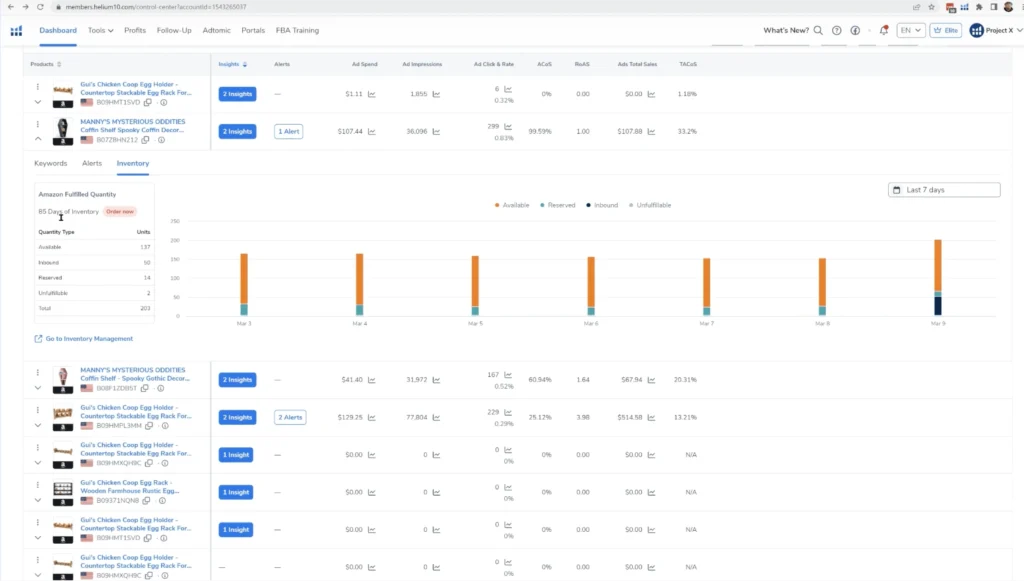
Helium 10 + AI Insights
Helium 10
I still rely heavily on traditional Amazon data tools for:
- keyword volume
- sales estimates
- competitor tracking
- listing analysis
AI works best when combined with real marketplace data.
Common Mistakes Sellers Make With AI
1. Blindly Trusting AI Recommendations
AI is not always accurate.
Some sellers follow AI-generated ideas without verifying demand or competition.
That’s risky.
2. Chasing “Winning Products”
AI cannot magically predict guaranteed winners.
Successful product research still requires:
- strategy
- validation
- business judgment
3. Ignoring Customer Psychology
Many people only use AI for data.
But emotional insights matter just as much.
Understanding why customers buy is critical.
4. Overcomplicating Research
Some sellers use too many AI tools at once.
That creates confusion.
Simple systems usually work better.
My Actual Workflow in 2026
Here’s the simplified version of how I use AI during product research:
Step 1 — Find Product Ideas
Using Amazon browsing, trends, and market observation.
Step 2 — Analyze Demand
Using keyword and sales data tools.
Step 3 — Use AI for Review Analysis
Identify customer frustrations and opportunities.
Step 4 — Validate Competition
Study listing quality, branding, and positioning.
Step 5 — Check Margins & PPC Reality
Ensure the product can actually scale profitably.
Step 6 — Look for Branding Potential
The niche must allow differentiation.
The Biggest Advantage AI Gives Me
The biggest advantage is not automation.
It’s clarity.
AI helps organize information faster so I can focus on:
- decision-making
- strategy
- positioning
- execution
Instead of drowning in manual research.
That saves massive amounts of time.
Final Thoughts
AI has become one of the most useful tools in modern Amazon product research.
But the sellers succeeding with AI are not relying on it blindly.
They’re using it to:
- improve research speed
- understand customers better
- analyze niches deeper
- make smarter business decisions
At the end of the day, AI is still just a tool.
The real advantage comes from how you use the information.
And in 2026, sellers who combine AI with real market understanding will have a serious edge over everyone else.